Wednesday, November 4, 2015

Subway

I bet you don't know this:

1. Submarine sandwiches have their origin in the United States. Really! That's what they say. They originated with the Italian American labor force in Northeastern of the US. Could it be this was at the time of the Corleone family? In case you do not know, that's the GodFather, the Don.
2. The subs showed up on local pizzerias, but pizza-maker was at the bottom of the culinary and social scale, so they added the subs to feel more dignified.
3. The largest sub chain in the world is Subway.

And here I am in line to stuff myself with about 456+ calories, with no less than 2.3 grams of polyunsaturated fat and 8 grams of monounsaturated fat. Not to mention 1,651 milligrams of salt. But my poor heart loves this!

Here is the legal warning,.. meaning eat this at your own risk.

Amount Per 1 submarine (228 g)
Calories 456

% Daily Value*
Total Fat 19 g 29%
Saturated fat 7 g 35%
Polyunsaturated fat 2.3 g
Monounsaturated fat 8 g
Cholesterol 36 mg 12%
Sodium 1,651 mg 68%
Potassium 394 mg 11%
Total Carbohydrate 51 g 17%
Protein 22 g 44%
Vitamin A 8% Vitamin C 20%
Calcium 18% Iron 13%
Vitamin B-6 5% Vitamin B-12 18%
Magnesium 17%
*Percent Daily Values are based on a 2,000 calorie diet.

I indulged a foot long Italian B.M.T. In term of added trimmings, I got cheese, lettuce, tomato, spinach, pickle, mayonnaise, chipotle, vinegar, salt and pepper. Shouldn't have added the extra salt, but what the heck!

I like the Apple logo on the BIG man in front of me. May be if I eat one of this every day, I'll be as big.

My Sub

Tuesday, November 3, 2015

Insignificant!

This photo was taken around high noon today. I was all by myself without any other Homo sapiens within a stone's throw. It's November but the sun was scorching, hot and humid. Luckily, it was too hot for the mosquitoes and not one came to collect my blood. Look up in the sky and you can see an airliner probably taking off minutes ago from Miami International airport about 16 miles due North of this location. There must be many human beings in that flying craft heading southwesterly to who knows where? In the foreground, you see a lone grey egret. He/she is my friend for the moment but never let me get close. Some friend, I am telling you. The dead palm tree is not cut down because some family of birds lives there.

And this is Miami today... with me in it, insignificant being in an infinitesimally small piece of earth on a trifling third rock from a banal mid life star within an inconsequential galaxy... This reminds me of an obscure poem by an unknown poet:

O dark, dark , dark...
They all go into the dark...
The interstellar spaces...
The vacuum into the vacuum.

With the sun in my back, this is my dark side on a nugatory Tuesday.
My Dark Side

Saturday, October 31, 2015

Mom, Dad and Descendants...

Here I am again... trying to resurrect from the ashes and blogging again. To close down this month, let me talk about my pet project for the past 5 years plus: the search for the Alstonia scholaris. If you are as obsessed with this tree as I am, search my blog for "Alstonia" and "Hoa Sua" and you will find a lot of information related to this.
The photo of this Alstonia scholaris is taken at 6:23 PM on Thursday, October 29th, 2015 in the Fairchild Tropical Botanical Garden (FTBG.) Its location on earth is: Latitude, 25:40:32.74 - and Longitude, -80:16:30.28. After so many years, I am happy to learn that the Alstonia scholaris can flower successively twice, peaking in mid-month and then again at the end of October in a year with lots of rain like this is. This tree peaked on October 12th and again right now, at the end of October. On the date of this photo, the sweet scent permeated the surrounding air, especially when you are downwind. The ground around the tree looks sandy white, but that is not sand. They are the tiny milky white flowers that fall as rain all day and night long. A truly beautiful site! I can now say for certain that for me, the scent is sweet, delightful and not pungent and overpowering at all. It begins at dusk and lasts until dawn. This tree, with my help, is the proud Mom (and me as surrogate Dad, I guess) of a whole bunch of siblings from the seeds I germinated in March 2012, 3 and a half years ago. I now have one in my backyard that is about 20 feet tall, and three more found their permanent home in Montgomery Botanical Center (search Montgomery in my blog) where they are growing beautifully. I am trying to grow three more as bonzai although I have no such skill as yet. I want to learn about how long before these trees will begin to bloom... Return here in a few years, give or take one or two... Have you had enough of Alstonia?
Mom Tree

Friday, October 30, 2015

I AM ecstatic!

No, I am NOT a person subject to mystical experiences (aka an ecstatic,) but I am just ecstatic! That prompted me to revive this blog after a LONG, LONG hibernation. Can't believe I am doing this stunt!

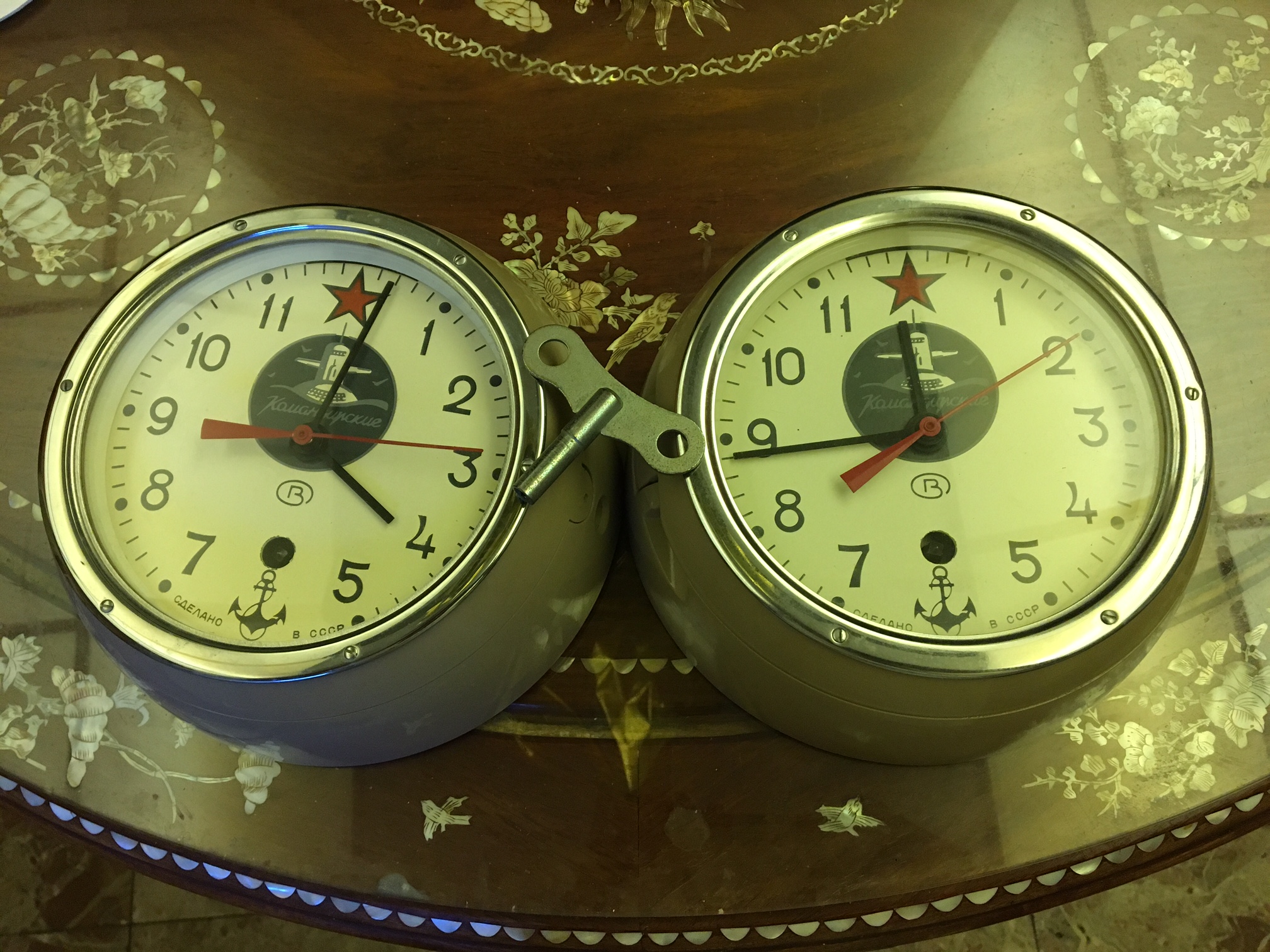
Well, I am ecstatic because I just made an easy US $2,752.50 without even breaking a sweat, and I got my two Russian submarine clocks working again after a LONG, LONG time playing dead.
My two clocks were dead simply because their second hands just would not move. Today I found a place that says it can fix Russian submarine clocks. O joy! Of course I called the repair business and decided to take my two clocks there for an estimate to repair them.
While preparing both clocks, the second hands moved... and I thought a ghost was in action because we are so close to Halloween (I hope you who are reading this blog and are not from the US know what that day is...) But then they stopped again. Because the clock repair business is way up North of me, I decided to fiddle with and with a stroke of genius, fixed both in a record 15 minutes. So...
If I were to take my two clocks to the repair shop up North that is 75 miles away, I will have to drive round trip twice, once to drop them and once to get them back after repair. That is 75 x 4 = 300 miles. It takes me 1 hour 15 minutes each way... that is a total of 5 hours of driving my car.
The IRS and also the US federal government allow a mileage reimbursement rate of 57.5 cent for each mile. These two trips would cost me $ 172.50. All my friends, the lawyer sharks type charge a minimum of $500 per hour. I am better than they are, but will only charge the same rate. That is $ 2,500 for my "valuable" time. I estimate a minimum repair charge for each clock is $ 40.00.

So, drum roll please, I made $ 2,500.00 + 172.50 + 80.00 = $ 2,752.50 without breaking a sweat. (Actually, in Miami, it costs me $.75 per mile to drive my car...)

I love my two Russian submarine clocks that are now happily ticking every second. Ain't life grand?
I'll be back! Believe it or not!
I am BACK!

Saturday, May 3, 2014

Ochna unknowna

This is so exquisite a flowering plant that I must talk about it here. I have this small plant for many years and always have the itch to know its species name but it is so far but a line on my bucket list! This clearly belongs to the genus Ochna but it is much smaller and very slow growing. The flowers are similar to that of other species of Ochna, but smaller. What particularly differentiates this species from its other relatives is that all the flowers face the ground when opened. After flowering, this Ochna produces the same black seeds that earned the familiar nickname "Micky Mouse." The seeds are quite easily germinated into small and very very slow growing plants. So... my now project is what is this species? I know this is not to be confused with Ochna species grown as bonsai at nurseries.
Ochna but what?

Friday, May 2, 2014

What's That?

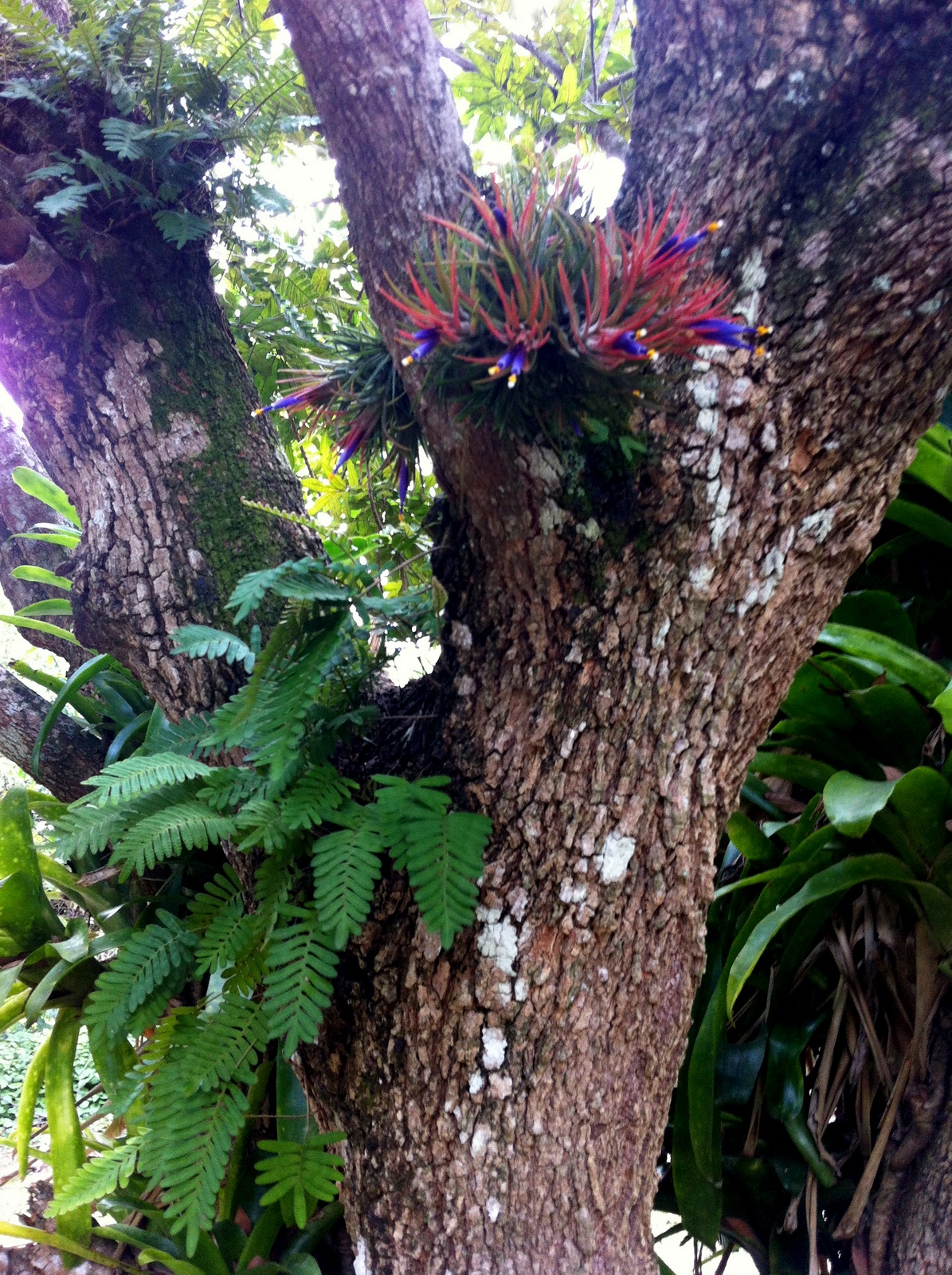
In my last blog, I did not identify the beautiful miniature bromeliad. Now it's the time to do that. It's "Tillandsia ionantha!"

Tillandsia ionantha is a species of the genus Tillandsia which is native to Costa Rica and Mexico. This tiny plant has leaves with hue in deep shade of green, turning to a beautiful red/pink color before its purple and yellow colored tiny blooms appear that last a few days. That's the color you saw in my blog of Wednesday, April 9th, 2014. After blooming, the leaves return to its green color as seen here. The genus Tillandsia has about 650 species. I have another species that was shown in a previous blog. I identified it as Tillandsia tenuifolia. That was incorrect! Instead, my other miniature bromeliad is Tillandsia stricta. I now stand corrected. Now I have the desire to look for others of this beautiful genus to add to the two I now have. Will this ever end?
Errata in the year 2008

Wednesday, April 9, 2014

Pleopeltis polypodioides

On the left side of this photo is the amazing "resurrection fern (Pleopeltis polypodioides.)" It looks wonderfully "green" but you'd never guessed that just minutes ago, it was but a mass of brown wrinkled curled up desiccated fronds. This epiphyte fern lives on the trunks of large trees such as this longan tree. It gets the resurrection name because this fern can survive long, long, long periods of drought by curling up its fronds and appearing dead. When just a little rain would come, it uncurls, reopens and "resurrect," restoring itself to a vivid green color that you see.

I can't believe that it is estimated that these plants could last hundreds of years without water and still revive after a single exposure to the rain! Most plants, during drought periods, die after they lose about 10% of their water. This fern can lose up to 97% of its water and remains alive waiting for the rain to resurrect.

You see the beautiful purple and yellow tiny blooms above to the right? What's that?
I'm Not Dead!

Thursday, March 27, 2014

Why Can't I?

Now, why... why... why can I not grow lotus to be like this one here? This is again from my friend "tog" (The Opiniated Gardener) of Coral Gables. This single lotus is HUGE. It is about 9 inches in diameter. I am mad, mad, mad! And jealous too!

But, I am not without skills though because after more than five years of tireless searching, I finally germinated and planted my first Alstonia scholaris in my backyard. Want to see it? It is so beautiful I baptized it ... well, you'll never be able to guess its name.
I wish it's mine

Sunday, March 9, 2014

Trader Joe's

This is the location where the Borders Book Shop used to stand until it went bankrupt back in July of the year 2011. City Furniture moved in briefly and it now becomes another trendy grocery store, "Trader Joe's."

I went in this store when it first opened, then again in a memorable night during a torrential Miami rain. This store is rather small and it is the first of its kind in Miami. I wonder how it will fare in the face of fierce competition that is the norm in this city.
Trader Joe's

Sunday, March 2, 2014

Thunbergia ma non grandiflora

This beautiful floral display never fails to get my attention a few times every year. Every time, I take a few snap shots, tuck them away and then forget about them... not today! For years, I always thought that this is the Thunbergia grandiflora... but it is not. This is a Thunbergia laurifolia. What's the big deal, wouldn't you say? However, listen to this: If this was the first kind, it would have come from India while being the latter it must have come from Myanmar. I like that better. The truth is you can tell by looking at the shapes of the leaves, but trust me, this is a laurifolia.

Now read this: "In Malaysia, juice from crushed leaves of T. laurifolia are taken for menorrhagia, placed into the ear for deafness, and applied for poulticing cuts and boils (Burkill, 1966). In Thailand, leaves are used as an antipyretic, as well as an antidote for detoxifying poisons (Kanchanapoom et al., 2002). Several Thai herbal companies have started producing and exporting rang jeud tea (Chan & Lim, 2006). The tea has been claimed to be able to detoxify the harmful effects of drugs, alcohol and cigarettes."

Furthermore: "Iridoid glucosides have been isolated from T. laurifolia (Kanchanapoom et al., 2002). Microwave-dried leaves displayed stronger antioxidant properties (AOP) than fresh leaves (Chan & Lim, 2006). AOP of infusion from microwave-dried leaves were higher than the commercial rang jeud tea from Thailand."

If there are words in the two paragraphs above that you are not sure to know, please look them up yourself because I also don't know what they mean. But these leaves make good tea is how I see it.

You know, I have tried to grow lotus flowers for the last couple of years, but was not too successful. There are some nocturnal critters that come to feed off my lotus because the root tubers are so delicious so it seems and I am too sentimental to shoot them with my bibi gun. Would you now tell me to grow these blue trumpet flowers instead? I don't think so! Lotus is much more beautiful and it's a challenge for me to get them, so I will persevere. Besides, this vine is very invasive and it certainly will give me lots of work to trim it back.
Blue Trompet Vine

Tuesday, February 25, 2014

Herbarium

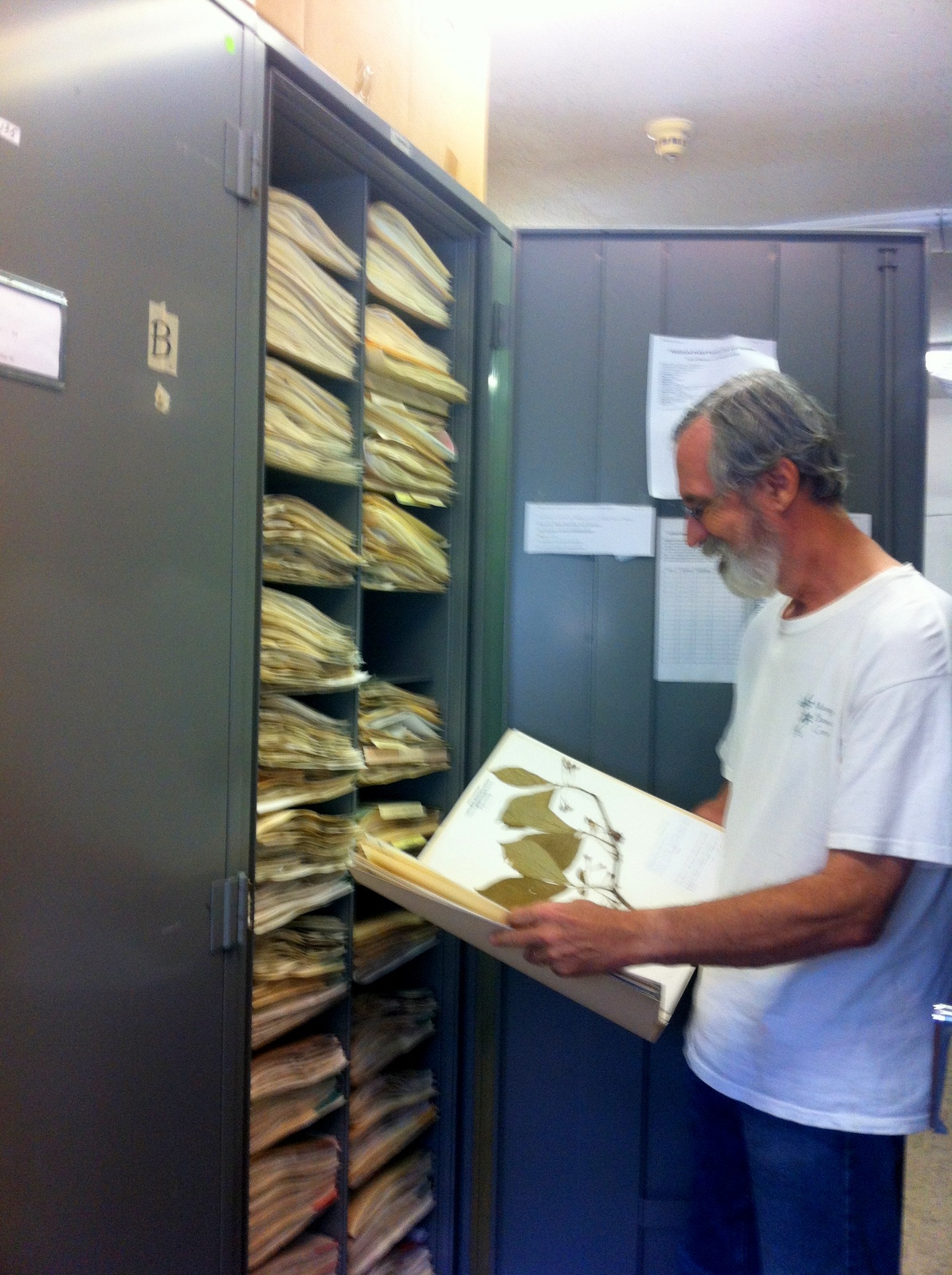
Just when I thought I know about everything, my friend Larry, Palm biologist, Ph. D. taught me a new thing I did not know anything about: a herbarium, which is a library where all kinds of plant specimens are stored and made available to scientists doing research on plants. The specimens in herbaria (that's the plural form of herbarium) are often used as reference material in describing plant taxa.

This herbarium belongs to Fairchild Tropical Botanic Garden, and it now houses the collection that belonged to the Florida Atlantic University.

Plant specimens collected in the wild are identified, parts of which are then prepared by preservation techniques that are quite involved: pressed, dried, frozen, mounted and stored away in controlled environments. The photo shows Larry pretending to look up some specimens that are stored as families with weird botanical binomial names. So, if you do not know the family name of a species of plant that you are interested in, good luck to look it up in here.

France has the largest herbarium in the world: Musée national d’histoire naturelle, located in Paris, France and in many other parts of the country. It is no surprise the French are on top here because France started the first ever herbarium, the Royal Medicinal Plant Garden created by King Louis XIII (pronounced ex aye aye aye) in 1635. I guess when the King was not feeling well, he had at his disposal tons of magical herbs he can try out. Later, the boy-king Louis XV (pronounced ex vee) on 31 March 1718, removed the medicinal part and changed it to the Jardin du Roi (King's Garden)—to focus on natural history. He obviously did not like to taste the weird plant roots. There, you now know as much about herbaria as I do.

Cheerio!
Petrified

Saturday, February 22, 2014

Long-jawed orb weaver

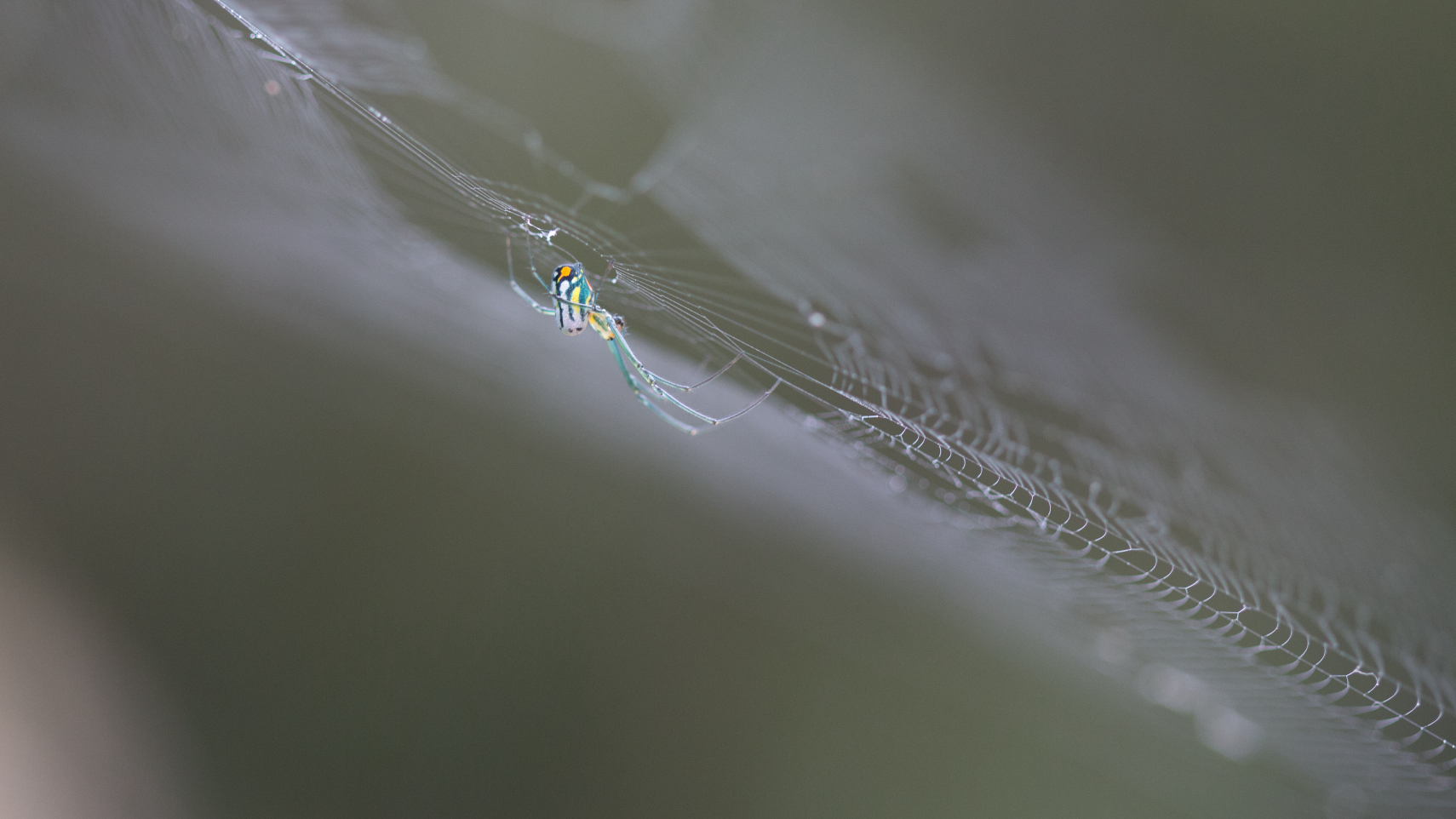
My backyard is full of sticky webs. Navigating around, I need to be very careful not to destroy these homes built by spiders day in day out. If I were a Leucauge venusta, like the one in this photo, I would be very upset if you walked right through my home and I will have to start rebuilding it from scratch!

Do you know why this species has the name venusta in its binomial name Leucauge venusta? Look at the photo. It's beautiful! This photo is high resolution and you can click on it to see what I mean. Venusta means just that, beautiful in Latin. Remember Venus?

The orchard spider is a long-jawed orb-weaver spider. The Venusta orchard spider is among those orb weavers that spin their webs near the horizontal plane. Females almost always sit underneath, at the center bottom side up. These spiders are tiny. From above, they look like a pair of orange eyes watching you. These are the spots on their rear end. Quite deceiving, aren't they? Because they are hung upside down, the head is below, hidden by the beautiful long green legs.

It is not easy to take snap shots of these spiders whose webs constantly sway in the wind. I had to use my digital camera and a macro lens. If you are curious, this photo is resampled from a raw shot of 18 Megabyte using a 100mm Canon macro lens at widest aperture of f2.8, at the speed of 1/160 second and ISO 400.
Spider

Thursday, February 20, 2014

Medusa Gorgon

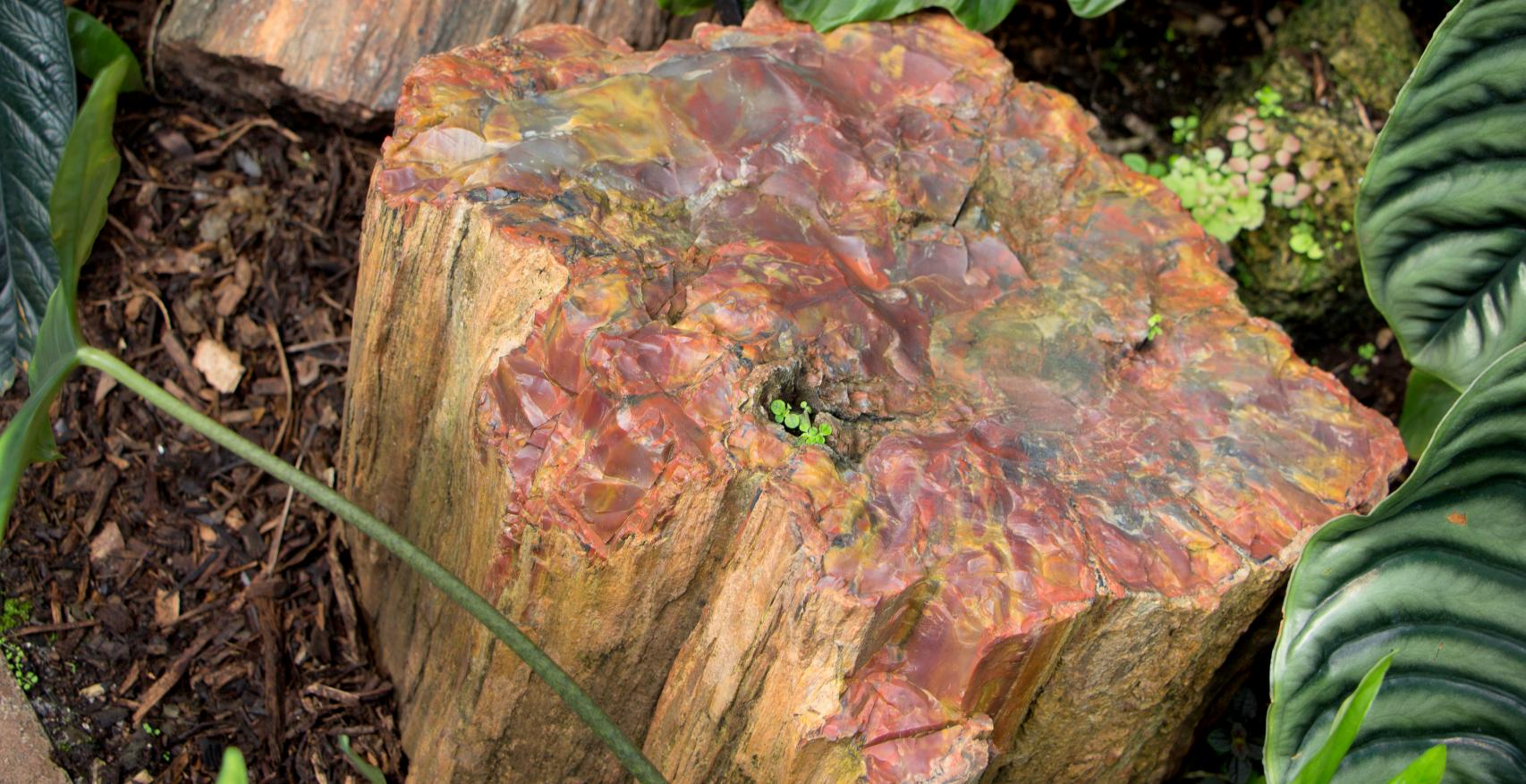
Wikipedia says, and I quote "Petrified wood (from the Greek root petro meaning "rock" or "stone"; literally "wood turned into stone") is the name given to a special type of fossilized remains of terrestrial vegetation. It is the result of a tree or tree-like plants having completely transitioned to stone by the process of permineralization. All the organic materials have been replaced with minerals (mostly a silicate, such as quartz), while retaining the original structure of the stem tissue."

Contaminating elements produce these related color hues:

carbon – black
cobalt – green/blue
chromium – green/blue
copper – green/blue
iron oxides – red, brown, and yellow
manganese – pink/orange
manganese oxides – blackish/yellow

Physically, the buried organic material is oxygen starved, but not completely dead while mineral-laden underground water flows through and deposits various mineral in the dying plants' cells.

Now you know how the deadly Medusa half-lady-half-snake Greek mythology creature turned foolish human warriors into stone. She used this process, but instead of it taking centuries, hers happened in two shakes of a lamb's tail.

But... Wikipedia talks again, and it says:

"Artificial petrified wood has been produced in a Washington laboratory. In the process small cubes of pine are soaked in an acid bath for two days, then in a silica solution for another two. The product is then cooked at 1400 °C in an argon atmosphere for two hours. The result was silicon carbide ceramic which preserved the intricate cell structure of the wood."

Now, can you tell me if this petrified specimen in the Fairchild Tropical Botanic Garden is real, or is instant man-made?
Petrified

Tuesday, February 18, 2014

Zamia furfuracea

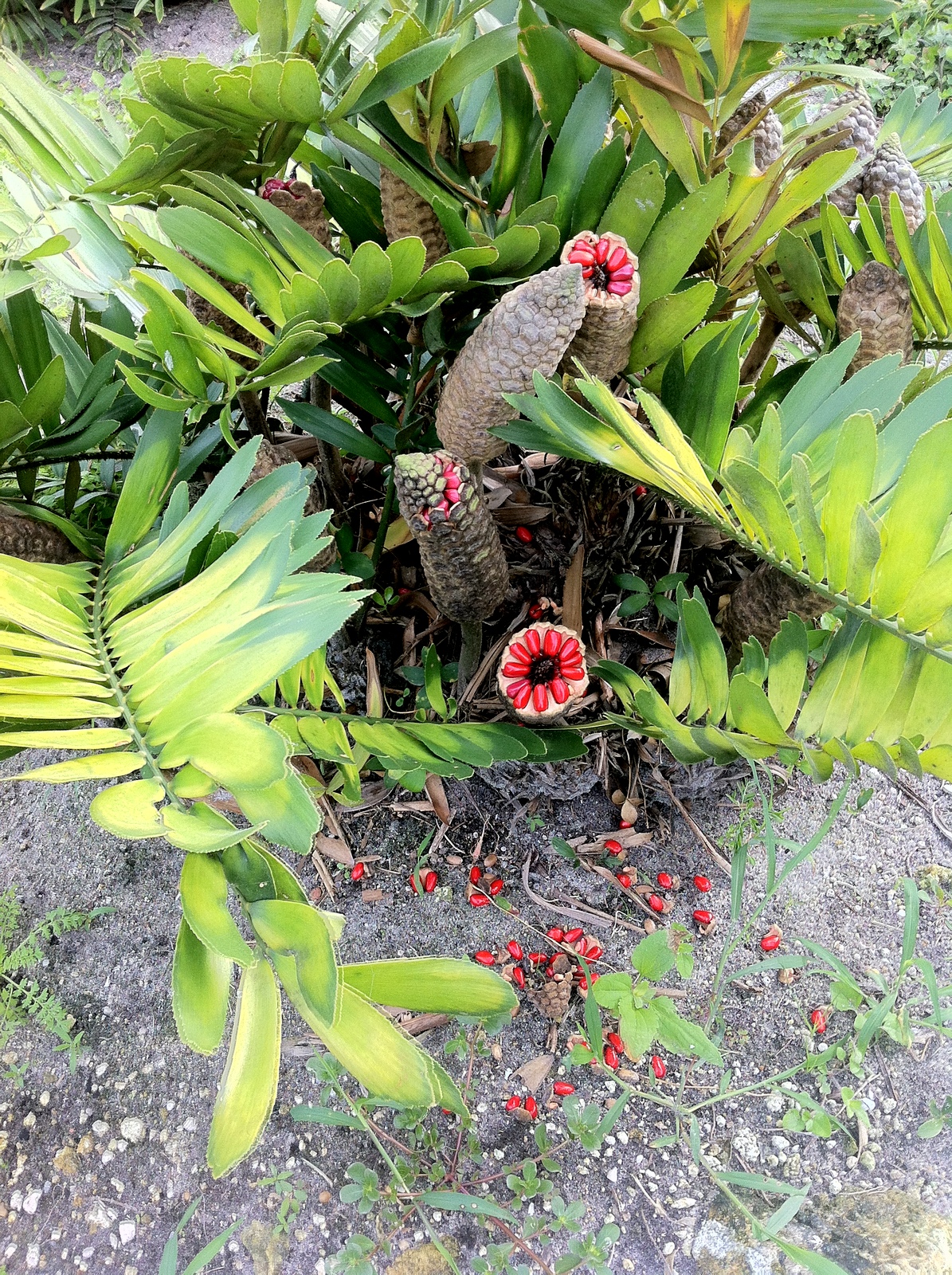
Look at this beautiful plant classified as an endangered species. It's a cycad native to southeastern Veracruz state in eastern Mexico bearing the scientific name of Zamia furfuracea. If you feel that's too exotic a name, you can call it by its alternate name of Cardboard Cycad. This is a female plant with child. It must be grown near a male plant to produce the egg-shaped cones bearing seeds. Pollination is by an insect named Rhopalotria mollis. Again, you can call this insect by its easier to remember name of belid weevil. I know, it's easy for me to say.

Cardboard Cycad plant can only be reproduced by the fleshy, brightly crimson-colored seeds as seen here. The germination process is very slow and difficult to achieve in cultivation. As a result, many plants sold for horticultural use are illegally collected in the wild, leading to the species being classified as endangered.

It's pretty, but you must know that all parts of this plant are poisonous to animals and humans. The toxicity causes liver and kidney failure, as well as eventual paralysis. Dehydration sets in very quickly. No treatment for the poisoning is currently known. Lucky for me to learn this because I thought this may make a good drink for the evening. Somehow, the animals all know this and these seeds are left untouched.
Pretty but Poisonous

Monday, February 17, 2014

Orchids Grow on Trees

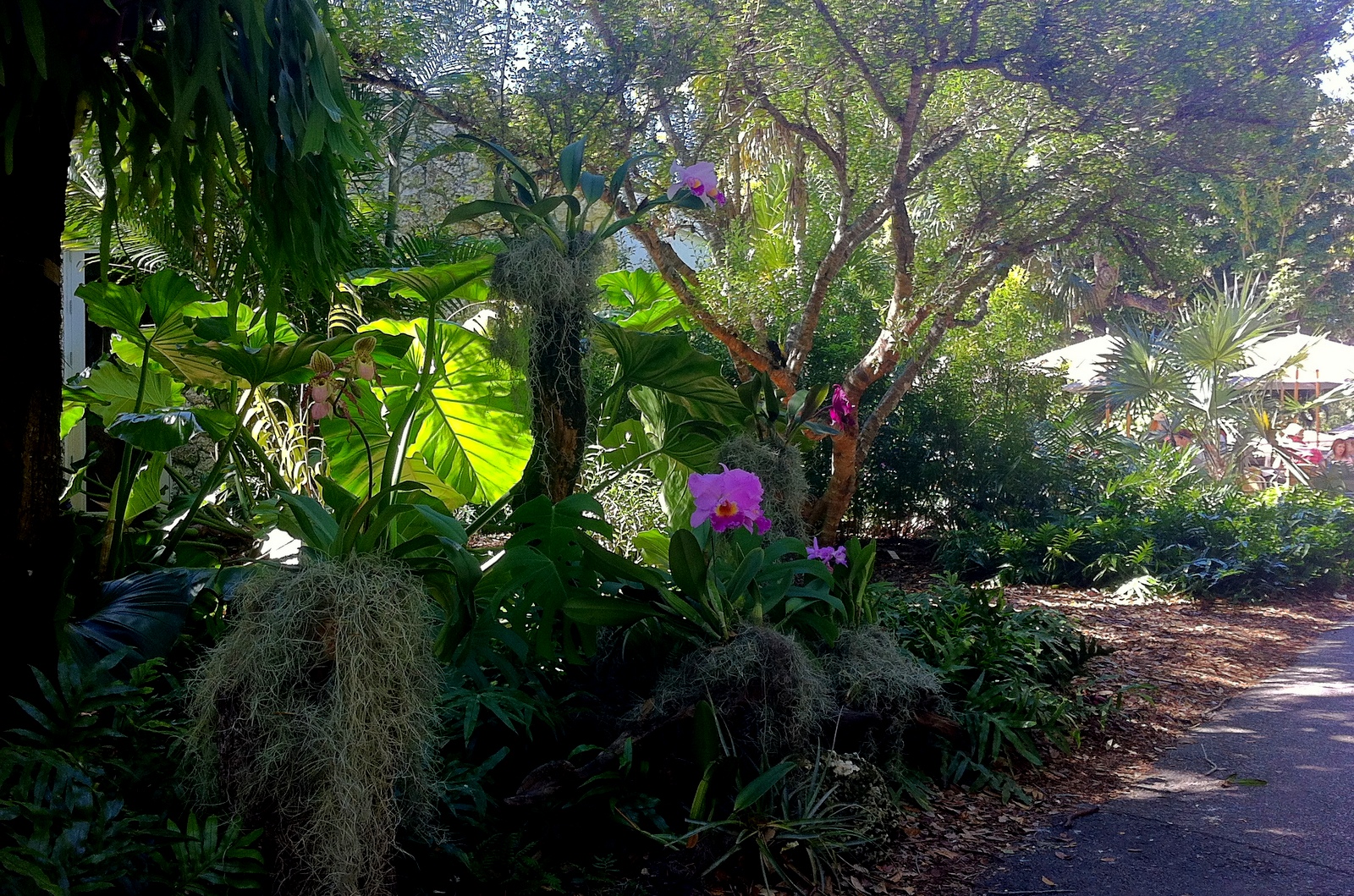
To clear up my mind, I took the time to return to Miami's Fairchild Tropical Botanic Garden this morning. Here is a look that can calm one's soul. These orchid plants are here for display, and not in their natural growing locations. But if you come here, look around and you will see many orchid plants attached to tree branches as orchids in their natural habitat. These blooms are always a feast for the eyes and senses.
Quint

Sunday, February 16, 2014

I'm Back... Sort of...

OK... Here is Miami Every Day trying to restart after a long, long, long, LONG sabbatical leave of absence. Actually, that is not entirely correct! It is more like I was busy in Miami's swamps with all kinds of alligators... and somehow I had to get out so here we go...

This is a very young and talented quintet from the University of Miami giving a free concert at the Fairchild Tropical Botanic Garden at 13:00 today. The students are in their third (Junior) year, obviously from the department of music. From left to right, the instruments are flute, oboe, horn, bassoon and clarinet. I didn't recognize any of the music, but it was delightful.
Quint

Tuesday, March 26, 2013

Metropolis I

This is a bird eye's view of Downtown Dadeland, from the 22nd floor of a unit in the Metropolis 1 condo, looking Northeasterly. Macy's is seen anchoring at the North end of Dadeland mall. To the right is US-1 whose North bound takes you to downtown Miami that is seen at the distant horizon.
Bicycle

Sunday, March 17, 2013

Say A Prayer

Six years ago, I was at the Church of the Little Flower, a beautiful Roman Catholic Church in Coral Gables. Here I am again, but this time, I am inside its very ornate interior, the church's altar where scuptured marble with inlaid is to be seen throughout the spacious spaces where religious rites are performned. Tonight, a special mass is conducted for my friend Edgard. Many friends who could not come to his funeral service because of time constraints came to pay their last respects. Another sad reminder of the ephemeric nature of life.
Bicycle

Friday, March 15, 2013

Green Beer

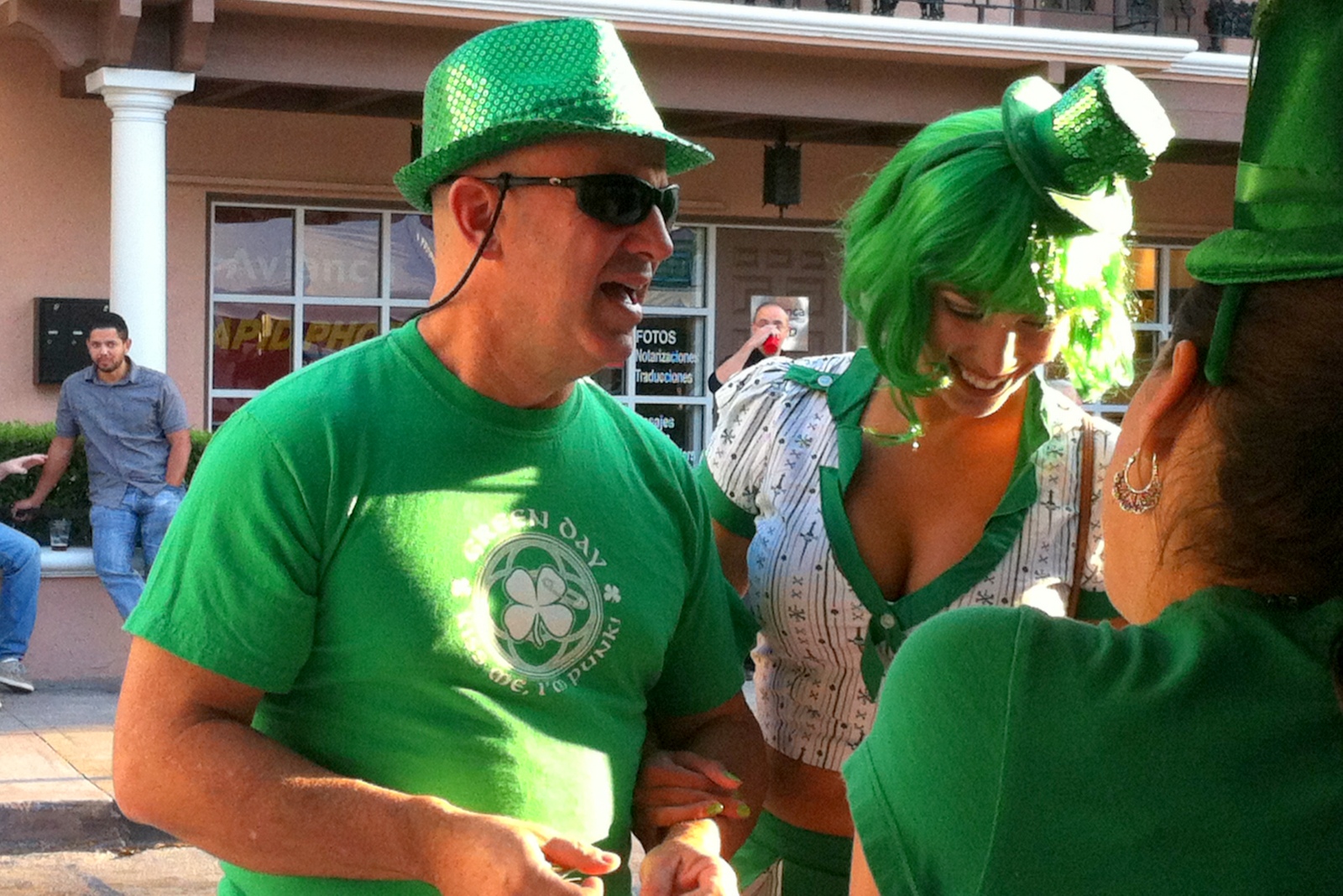
Although Saint Patrick's Day is not going to be until Saturday, March 17th, we in Miami can't wait so some streets in downtown Coral Gables are closed to traffic early evening today for an early celebration of all things GREEN sponsored by John Martin's Irish Pub & Restaurant.

Of course, you've got to dress green and drink beer: Guiness, Harp, Smithwick's (an Irish red ale style beer from Kilkenny, Ireland) or a mixture thereof. I am tired of pouring these kinds of brew for 3 hours. I'm kaput! Not drunk, but kaput!
Bicycle

Sunday, March 10, 2013

Orchids-A-Gogo

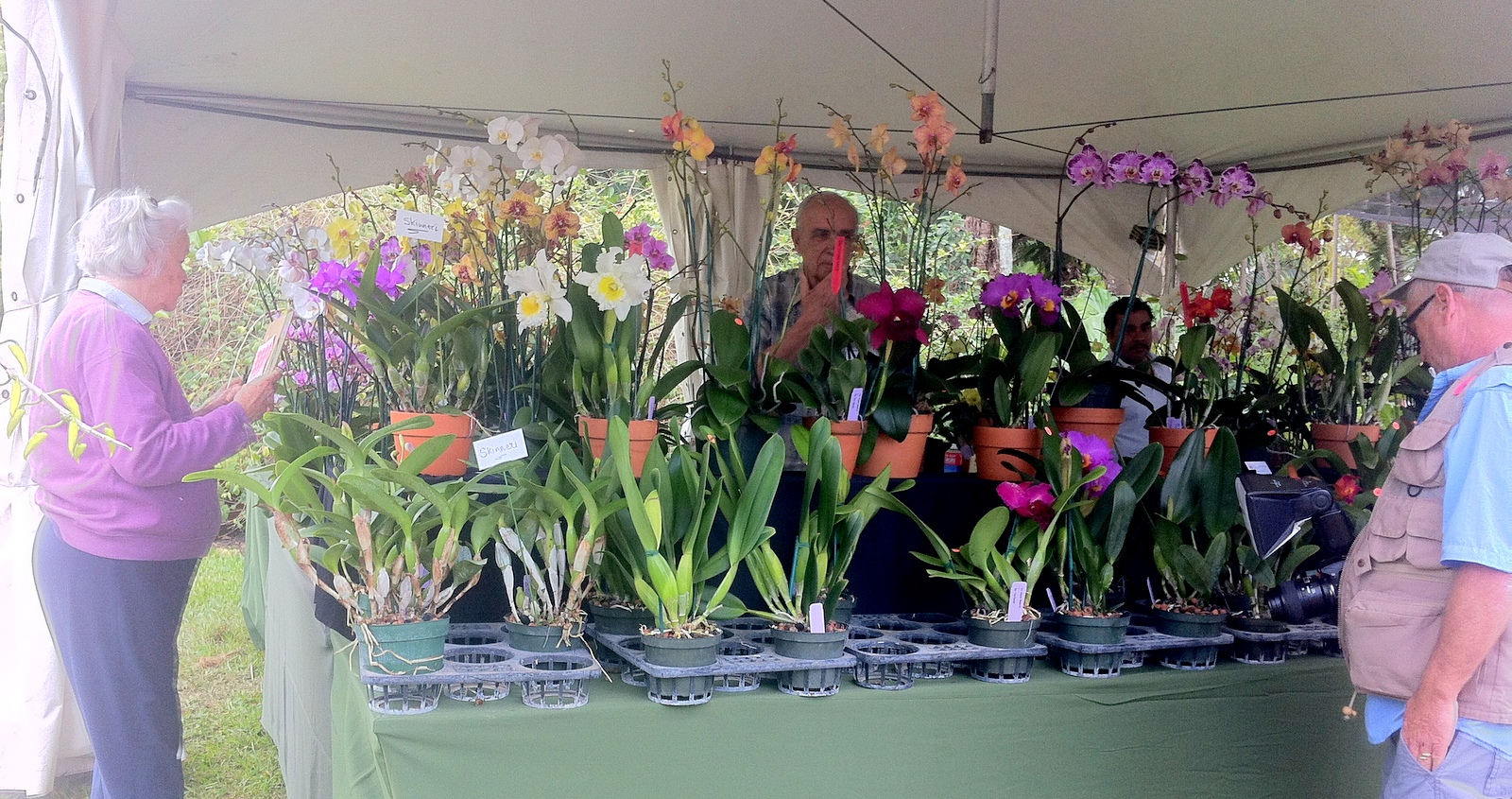
Today is the third and last day of the Orchid festival in Miami's Fairchild Tropical Botanic Garden at 10901 Old Cutler Rd, Coral Gables. It is really a chance for local orchid growers to sell their plants. There is a large number of growers who come with their many plants in full bloom. It's quite a feast for the eyes and the senses because many of the orchid species are fragrant. It is so easy to grow beautiful orchid plants here in Miami. It will take you a long time to kill your orchid plant by long term neglect here (what I do now...) but if you just spend a little time to give some minimal care, you can have beautiful orchid flowers year round.
Bicycle