Thursday, June 23, 2011

Ichiban

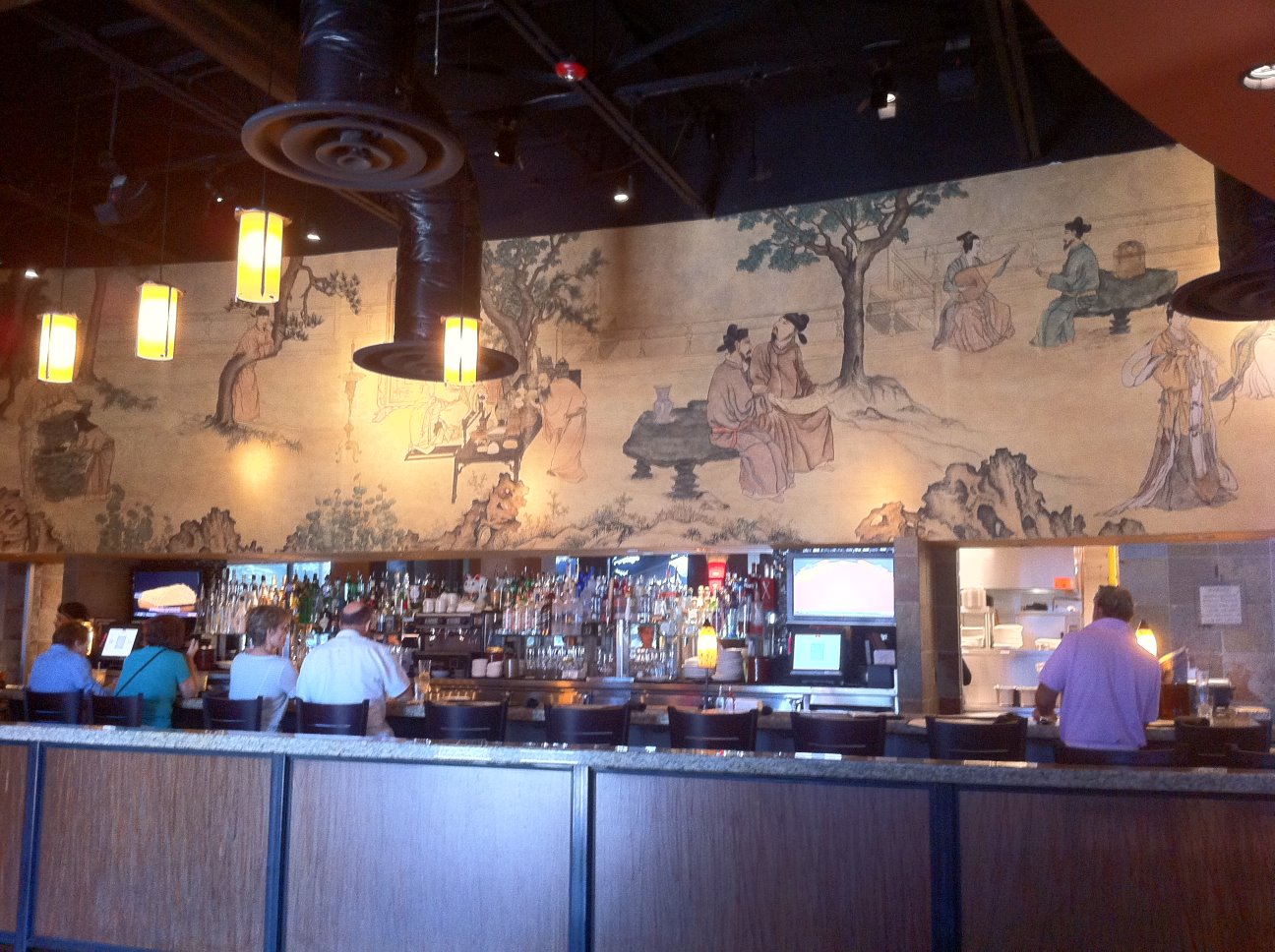
I had a late lunch today at this Ichiban Japanese Buffet in Doral, just West of NW 107th avenue and South of 58th Street. I begin to suspect that something is wrong with me, because all my friends love Japanese sushi, and I do not! Should I consult a psychotherapist? I still like the Shinju better than this one. Help!
Ichiban

Wednesday, June 22, 2011

Keitt Revisited

Here is another look at the Keitt mango tree. The fruits begin to show red blushes kissed by the sun. June is almost gone and they are expected to grow larger during the month of July.
Keitt Revisited

Tuesday, June 21, 2011

Rain Tree

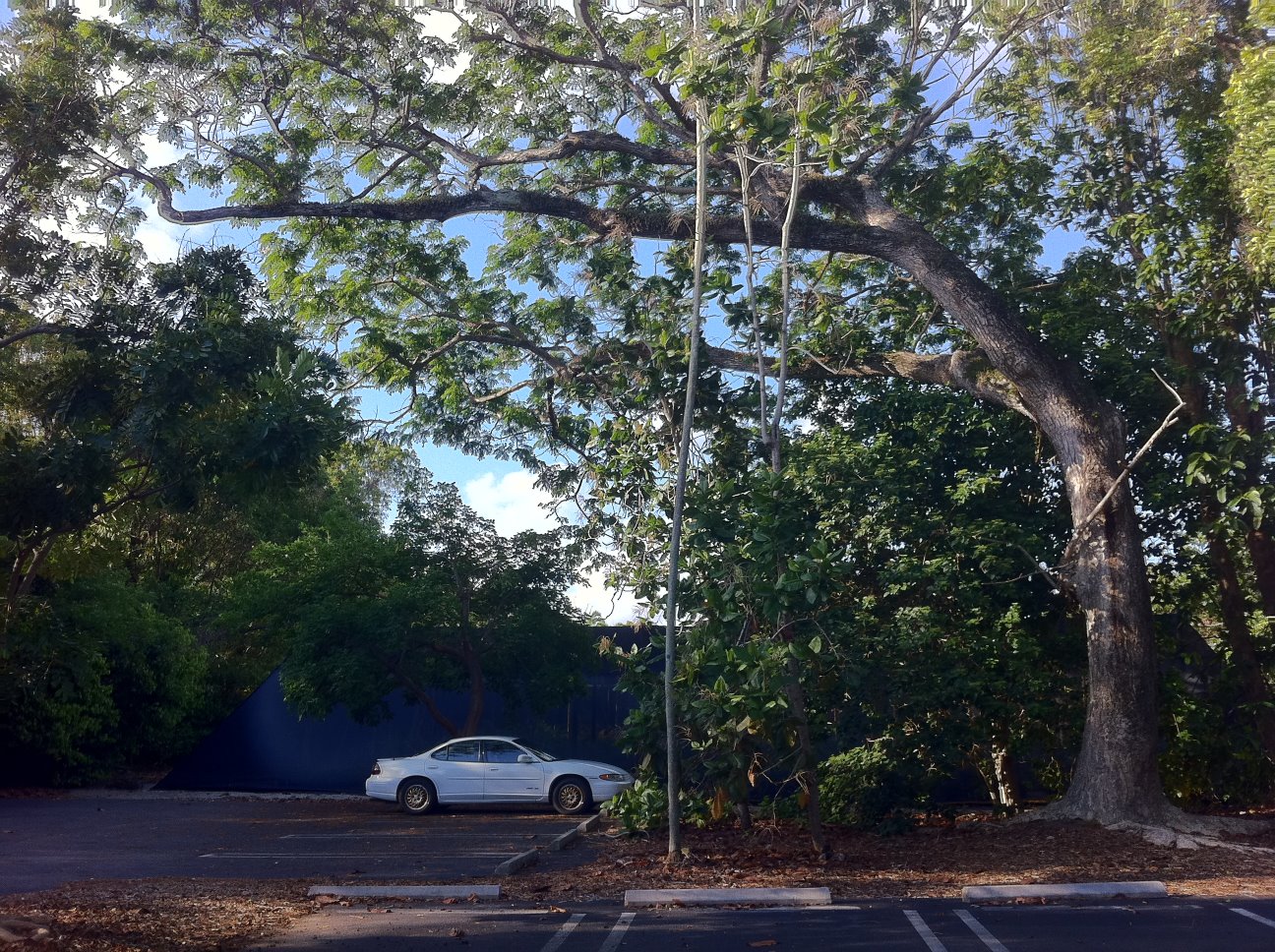
Native of Florida, Hawaii, Puerto Rico and the Virgin Islands, this is a rain tree (Samanea saman) of the Mimosaceae (Leguminoceae) family. Commonly known as rain tree, coco tamarind, acacia preta, french tamarind (because its seed pods look very similar to tamarind fruit pods,) saman, monkey pod, this is a large tropical tree that potentially can grow up to 180 ft tall with a crown up to 240 ft broad although they are smaller in the subtropics such as here in Miami.

Rain tree is a wide-canopied tree with a large and beautiful symmetrical crown, not like this one here. I suspect this tree was toppled during some of our very strong hurricanes, and it grew back the best it could, tilted to one side.

The folkloric uses of this tree is amazingly varied. In Venezuela, the roots are used against stomach cancer and in the West Indies, the seeds are chewed for sore throat. It is named rain tree because of the moisture that collects on the ground under the tree, largely the honeydew-like discharge of cicadas feeding on the leaves. The rain trees are champions for absorbing Co2. A large tree is able to recycle tens of tons of Co2 each year.
Saman

Monday, June 20, 2011

Aspergillus niger

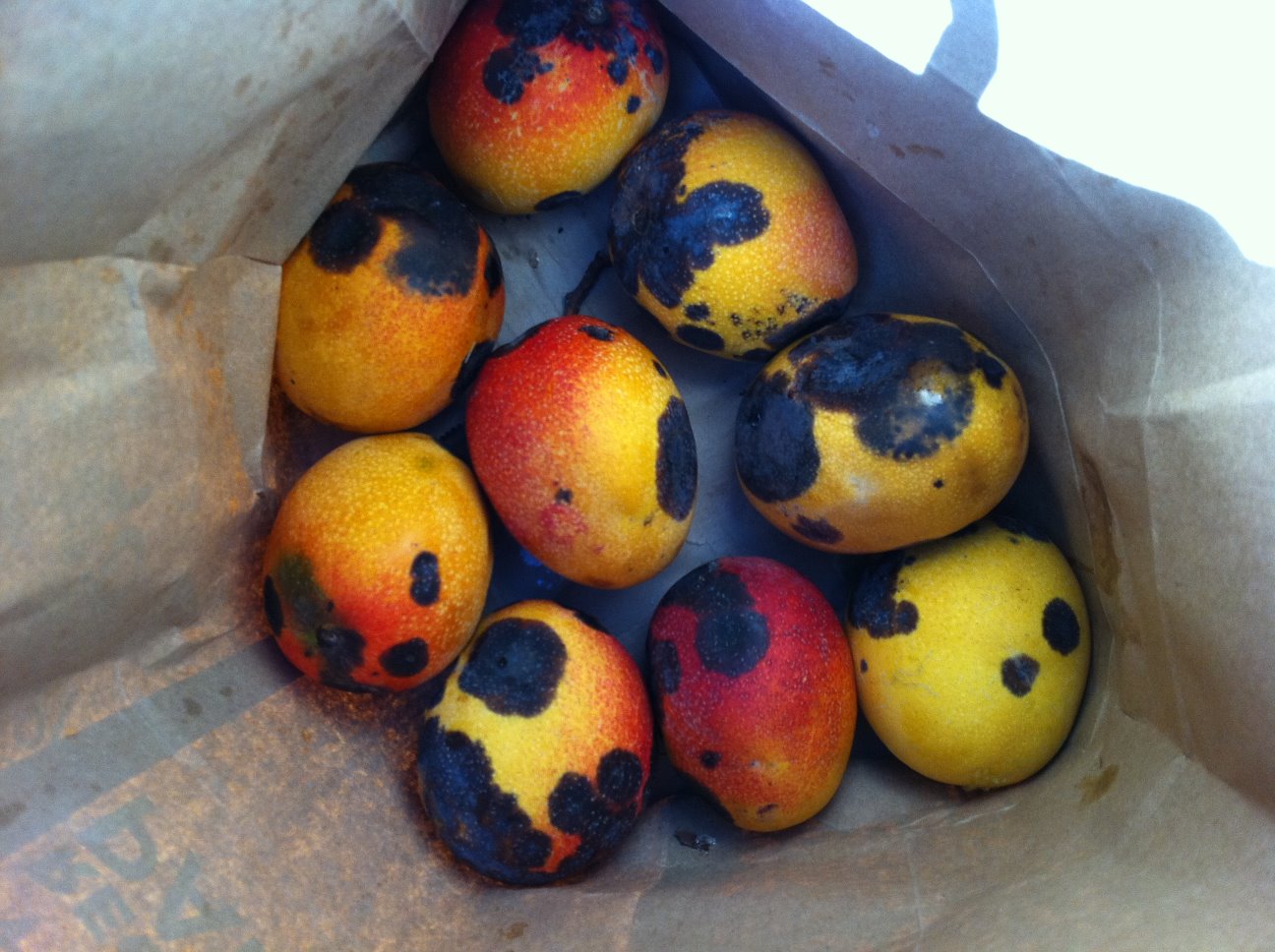
As a consolation for those of you who crave mangos and may get jealous seeing my unlimited supply of mangos this season, let me show you a dark side of this story. Life is not always as rosy as one would think it is. In this warm weather of subtropical Miami, we have all sorts of disease breeding insects and nasty microorganisms. They attack everything, including mangos, of course.

The two main diseases of mangoes are anthracnose and bacterial black spot.

Let's talk first about the milder form, bacterial infection, commonly known as the black rot (Ceratocystis paradoxa and Chalara paradoxa.) The bacterial black spot is often called bacterial canker (Xanthomonas campestris pv. mangiferaeindicae.) The spots have water soaked margins and fruit lesions consist of individual or multiple star shaped cracks, often appearing with anthracnose lesions in a tear stain pattern. Unlike anthracnose, bacterial lesions do not expand and spread as the fruits ripen.

The nasty one is anthracnose (Aspergillus niger, a filamentous fungus) which is a fungal disease caused by Colletotrichum gloeosporioides. It is known as black rot , but it should really be called black mold rot, a fungal disease, to differentiate this from its bacterial cousin above.

Anthracnose is usually only a problem in fruits that are ripening, as the fungus remains dormant in green fruits during the growing season. Little people know that when they eat a green mango, they may be ingesting entire colonies of fungi.Now that I am writing this, I am having second thought about my blog of the other day! When the fruits ripen, small dark spots form at first and then enlarge rapidly under favorable conditions, which are plentiful in Miami. Pink spore masses grow on the infected tissue. Such fruit has no market value. You are telling me? The spread is so rapid, all you can do is to get rid of them fast. Most of the time, it's not fast enough for me!

Now, you don't like mangos so much any more, right?
Rotten

Sunday, June 19, 2011

Sentinel Standing Guard

I really, really like this photo. It can keep me talking for hours... or write here ad infinitum... but do not be afraid, I will try to keep this short. Please remember that I kind of having a scientific background and not really believe in ghosts... although I am afraid of them, just like I am afraid of snakes and other scary things, too many to enumerate here. This photo was taken with my iPhone 4 at native resolution 2592 x 1936. It has been resized to 1296 x 968 for the web and was not edited at all except that this smart phone's camera processed three consecutive samples to improve the background contrast.

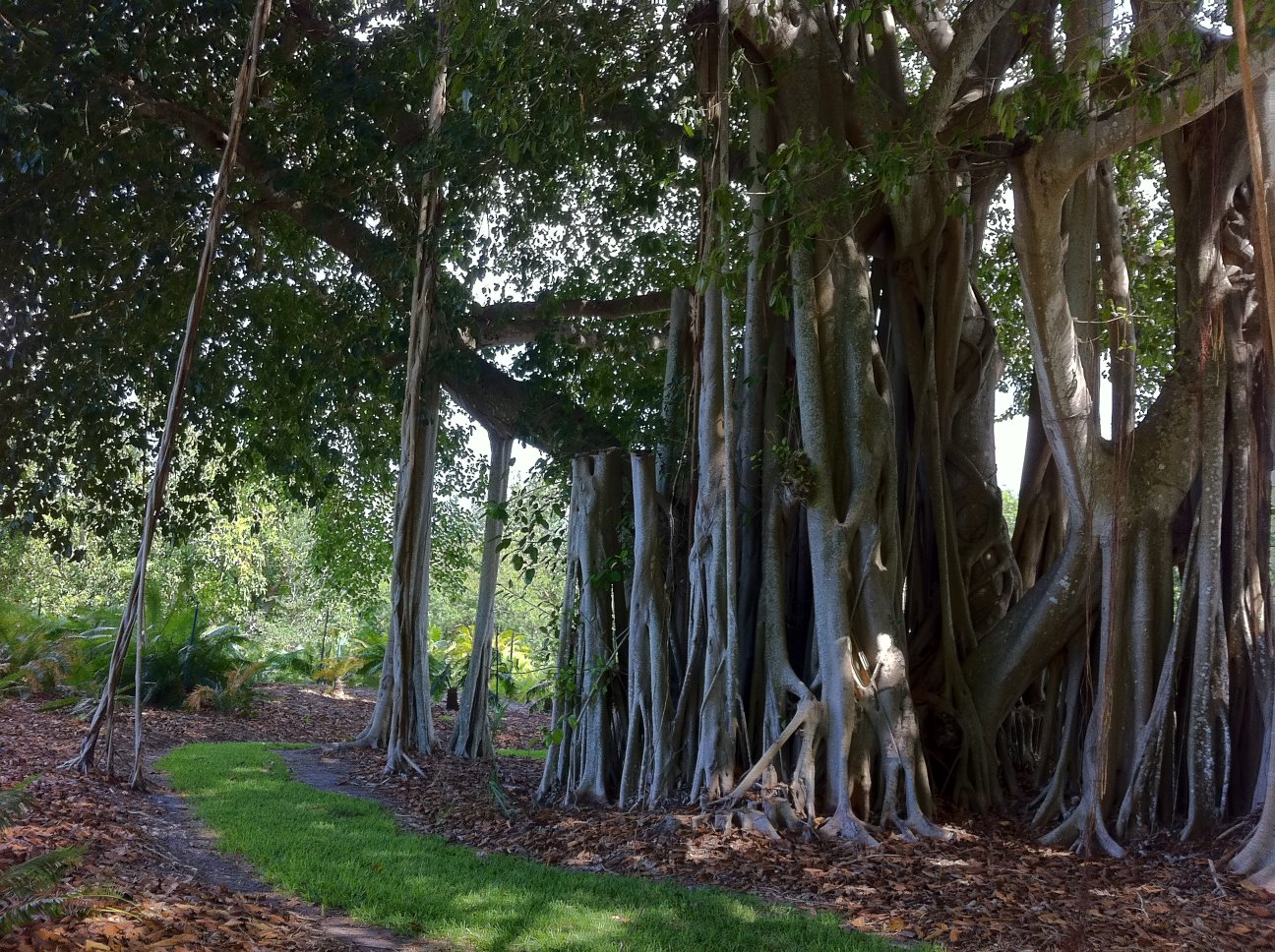
The main subject of today's blog is this tree, which is a stunningly beautiful fig tree. I was looking at it for an optimum angle to capture the aerial roots that help this tree anchor firmly and spread out. It is fascinating to look closely and observe the many new slender strings originating from the high branches to reach the ground where new roots develop to take hold and grow from there to make new trunks. Click on this image and you will be able to see how this system works.

Information about this species of fig is plentiful on the internet... such as this...

"The Banyan tree is the National Tree of India. This huge tree has the widest reaching roots of all known trees. It sends off new shoots from its roots, so that one tree is really a tangle of branches, roots, and trunks. The banyan tree regenerates and lives for an incredible length of time-thus it is thought of as the immortal tree. India has a long history of honoring this tree & it figures prominently in many of the oldest stories of the nation."

I am not sure about the US or other so called developed nations on earth, but in many nations in the continent of Asia, it is widely believed that many more stories can be told about the banyan trees. Notably, this kind of tree is always haunted in some way, and ghost stories abound.

With that in mind, someone, looking at this photo, may accuse me of doctoring it to hint at a "sentinel" figure standing right there at the center. Let me tell you that when I shot this picture, I was looking high up to frame the aerial root structures, so I did not see "him."

What do you think? Was he looking at me? Will he punish me because I took this photo without asking for permission? It does look like he is holding some kind of a long and sharp thing in his left hand! Mamma mia!
Banyan

Saturday, June 18, 2011

$4.25 Mocha Coconut

I came back to this Starbuck today and ordered a newly introduced small Mocha Coconut for US $4.25. With some eye strain, you can see this listed on the top left of the menu, under Frappucino. It was quite good, but a bit too rich and thick for my taste. It was just about ready to go in this snapshot when the man was about to squeeze some yummy dark chocolate and put a cap on top. It was good for an already scorching hot summer early afternoon.
Starbuck

Friday, June 17, 2011

Friday Stroll In The Park

Look closely and you can see the two little peachicks following their mom the peahen. Baby peafowls are born in the early spring, hatching from their eggs after a month of incubating. Female peachicks mature to become peahens and ready to lay their own eggs when they turn two.
Peachicks

Thursday, June 16, 2011

Mango Madness

I don't really want to overindulge, but I need to show you a new load of mangos that I just got. There are at least four kinds of mango here. The largest ones are Haden. I have not the faintest idea what the other ones are. I know of about 60 varieties of mangos with names from A to Z. But I am saving you from the nuisance of reading through them, and saving myself from typing them here. Suffice to say I love them all, and I can eat these fruits all day in lieu of breakfast, lunch and dinner. Come on, don't feel so bad because you live so far from Miami. If you want free mangos, come down here. End June is the peak of mango season.
Mangos, Again

Wednesday, June 15, 2011

Lychees Here

This year does seem to have a surplus of all sorts of fruits. On Sunset Drive, there is a family that sets up an improvised sale location in a van to sell lychees. Quite aggressive, they put up a large number of signs to attract motorists. Their signs say "Lychees Here." This sale has been going on for over a week and I think they must get the lychees from the groves further South in the Redland area North of Homestead. This enterprise seems to be thriving judging from the many cars that stopped to visit.
Lychees

Tuesday, June 14, 2011

Chez Lan

I was treated to a free lunch today and I did not have the luxury to select the restaurant. We ended up in Lan Pan Asian cafe at the Dadeland N metro rail station. I always wanted to try this restaurant and finally got my wish. It's kind of Japaneseish so I did not really like any item from the menu. But I survived. This place is quite popular and it was quite crowded at lunch today.
Sushi and Such

Monday, June 13, 2011

Clobbered

In the US, at this time every year, the National Basketball Association (NBA) is in its final days and the final games (there are seven) are played. Fans like to display their enthusiasm to support their teams. This year, the Miami Heat is one of the two final teams trying to become national champion. Yesterday, the Miami Heat lost its 6th game and the championship now belongs to Dallas's Maverick. The Heat was beat soundly and Miami is still recovering from the shock. This die hard fan has not given up and still driving around town with his banners flying high. I am sure he is not a happy camper today.
Dejected

Sunday, June 12, 2011

Aerial Roots

Here is a beautiful ficus tree with an impressive system of aerial roots. These trees send new roots from their tree trunk to help them firmly anchor in the ground for nutrition but mostly for support.
Ficus

Saturday, June 11, 2011

OD'd

This year, the mango trees are going wild and everybody who has them can't give them away fast enough. Needless to say, I am in heaven and every day trying not to OD'd on them. On the right are the Haden, and on the left, I am not quite sure. They could be Glenn, Kent, Irwin or even Jewel or Julie. But who cares?
Mango Mango

Friday, June 10, 2011

Not For Me

I really do not understand this at all. There must be a good financial incentive for this kind of advertising. I see many reasons why this is not a good idea unless a real patient is not the subject in display. The billboard says "Live lung cancer surgery." I really do not see the need to witness such serious surgical procedure. It is such a tragically private matter! Not for me!

The irony of it all is that red storefront sign underneath! This is near the Datran center in South Miami.
Not For Me

Thursday, June 9, 2011

Jackfruit Maturing... Slowly...

This is how this jackfruit tree (Artocarpus heterophyllus) looks today, as compared to a couple months ago. The fruits will grow much larger and it may take up to 8 months for them to mature. In Miami, these ripen end Summer, beginning Fall. When ripened, they emit a strong odor that may not be agreeable to those who are unaccustomed, but the same odor will make connoisseurs salivate. The seeds are edible simply by boiling them. They have the same laxative power as the feared western beans so if you do eat them, take it easy!
Jackfruit

Wednesday, June 8, 2011

Scent of Green Papaya

I consider myself very fortunate to live here in Miami. This is my steady supply of the main ingredient for one of my very favorite salad: green papaya. If I feel like making a "oh so good and crunchy" salad, it takes nothing to start with one of these fellows by a friendly raid to this tree. During mango season like now, I also raid my neighbor's Keitt for a green mango. I can assure you that there is no way you can tell the mango from the papaya. They look and taste identically to each other, and both are truly out of this world. The hard work is in julienning the papaya and the mango but that's fun. Want to see that dish? Or do you want my super secret recipe? Drop in!
Green Papaya

Tuesday, June 7, 2011

Not Round

Usually pizzas come in circles, meaning they are round in shape. Not the ones from this pizza place. In May 1996, Pizza Rustica opened its doors on the corner of 9th Street and Washington in Miami Beach, Florida. The people had never seen these Roman-style rectangular pans of pizza so it became a new sensation. It goes to say Italian Moms know best when it comes to pizzas. You guessed it, the owner of this chain learned to make pizzas from his Mom. Currently with 2 dozens locations in Florida, Arkansas, California, Michigan, Ohio, Texas, France and the Dominican Republic, this chain seems to be doing quite well even though I think they are still running under the radar as the round pizzas are still dominant here. This one is on Red Road just where it meets US-1.
Roman Pizzas

Monday, June 6, 2011

Limo for King Kong

Look at what I see today, a monster limo truck/SUV/whatever you want to call it. It is huge and possibly could take King Kong to the airport. This is the flagship limousine belonging to Royal Limousines service operating in North West Miami.

This is what they call their Stretch GMC Kodiac Top Kick that can sit 25 passengers. Their web says it has 4 flat screen TVs, DVD player, CD, fiber optic multi-color lighting, strobe light, ice bin, rock glasses, champagne flutes. cabin partition, hardwood floors and luxurious leather/ostrich interior. Whatever it has inside and for which purposes, its name is certainly a mouthful.
King Kong Limo

Sunday, June 5, 2011

Heliconia rostrata

I did not post any photos of this beautiful tropical flower for quite some time so I think it's about time to say a few words about these Heliconia rostrata. Again, this year, everything is about a month late. Usually, these flowers come in late April, early May but this year, they begin just about now.

Heliconia rostrata (Lobster claw, False-bird-of-paradise) is an herbaceous perennial native to the north western region of South America. Other Heliconias grow in the upright position and their cup-shaped flowers serve as water containers for birds and insects. This plant, however, has pendant flowers and they contain nectar. In the wild, Heliconias provide an important food source for forest hummingbirds. This Heliconia (named after Mount Helicon, the seat of the Muses, the nine goddesses of the arts and sciences in Greek mythology) rostrata (rostrata is a Latin adjective meaning beaked, curved, hooked, with a crooked point,) known as patujú, is the national flower of Bolivia. Their brightly colorful parts are not flowers. They are bracts designed to protect the tiny flowers with nectar so that only some special species of birds can access them: the humming birds.
Lobster Claws

Saturday, June 4, 2011

Fibonacci Cuts

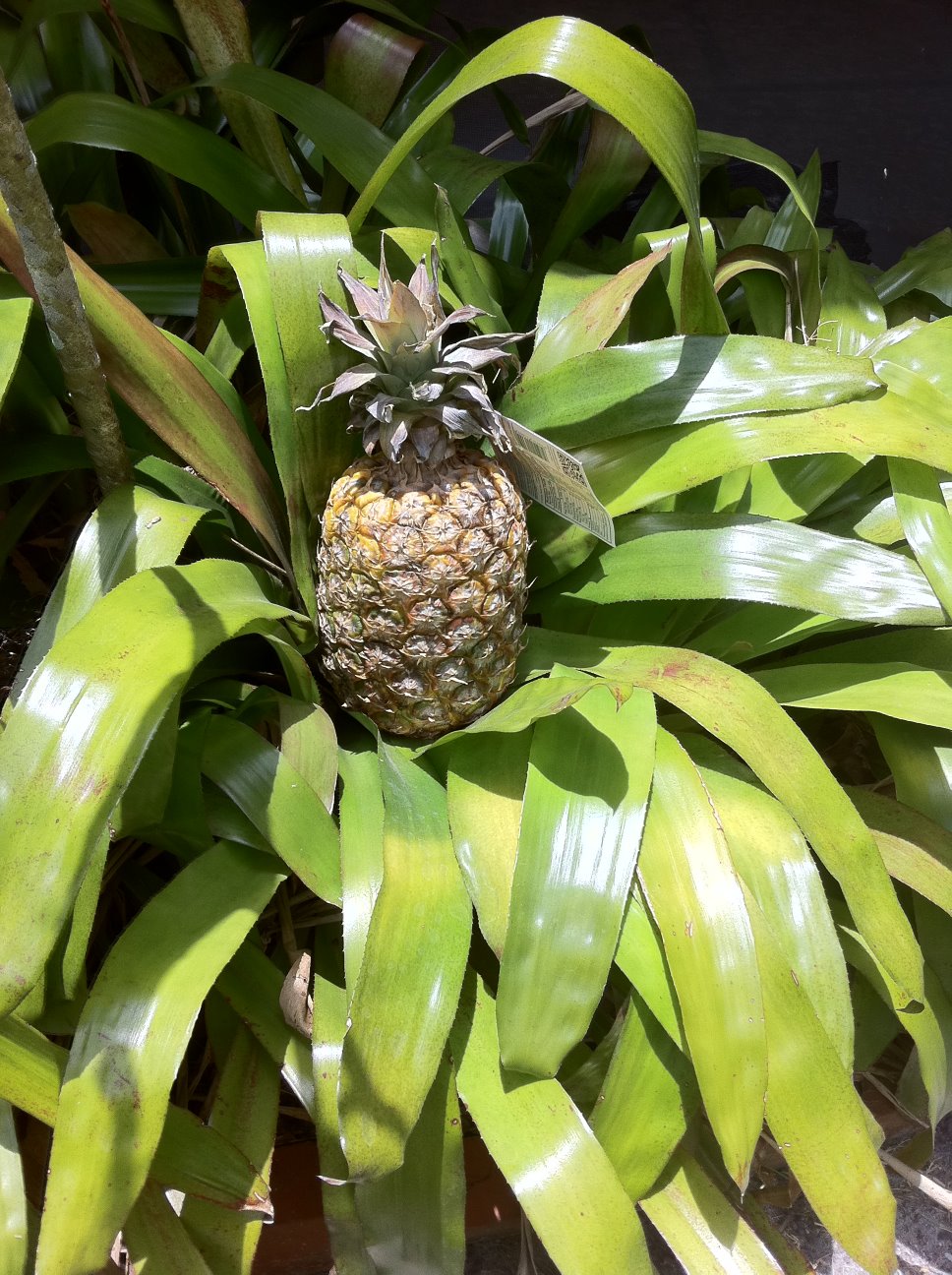
Remember my recent Cycad blog? Someone asked me an innocent question: is this related to the pineapple? I'm glad that was asked... because I did not know the answer so I had to do some homework for myself. In another seemingly unrelated vein, take a look at today's photo. My backyard got a... pineapple! Of course, that is just a joke on you, because this plant is not a cycad, nor that this pineapple sprouted out of it. This pineapple came from Publix supermarket. I bought it, thinking first that it looks and smells fantastic; and second that I would know what to do with it. Not even close! I have no idea how to cut this guy open, and it looks so forbidden, I am pretty sure I need help from someone more capable. A friend gave me a piece of advice: You'll need a sharp knife... a very sharp knife. But that is not my problem! My problem is how does one proceed. Then it dawned upon me that I had dealt with something similar before. Look here! Fibonacci!

This is the link that gives some sort of answer to the question above: Yes and No. Pineapple is not related to cycad, but both share the same passion: they love Fibonacci. What's that, you ask? Let's first talk about cycad. They reproduce by making seed cones that look pretty much like pineapples. These cones have spiral patterns. In some slender cones, one may notice 3 spirals veering to the left and 5 spirals moving oppositely, or vice versa. In larger ones, 5 and 8 spirals can be noticed, and some still larger cones may display 8 and 13 spirals: each set moving opposite to the other. Giant cones may have as many as 21 spirals. These numbers (3, 5, 8, 13 & 21) form part of a numerical sequence known as Fibonacci numbers which came from the work of a 13th century Italian mathematician, Leonardo da Pisa. The sequence begins with these terms: 1, 1,2,3,5,8, 13,21,34,.. and so on. Except the first two numbers, any term in the sequence is obtained by adding the two preceding numbers. The sequence is thus non-ending. We call it an infinite series.

Pineapple scales are also Fibonacci-patterned into spirals and because they are roughly hexagonal in shape, three distinct sets of spirals may be observed. One set of 5 parallel spirals ascends at a shallow angle to the right, a second set of 8 parallel spirals ascends more steeply to the left and possibly a third set of 13 parallel spirals ascends very steeply to the right. To have 13 spirals, you would have to get a very large pineapple. Mine has either 5 or 8. So I need to know if I should cut this following the 5 or the 8 spirals. See? Not so trivial! I probably will make a plant out of this baby instead of trying to perform surgery on it with a ceramic knife with which I am sure I will cut my fingers to pieces.
Fibonacci Cut

Friday, June 3, 2011

All-You-Can-Stuff

This is another blog that may give a feeling that all I do is to go around Miami stuffing myself with food. Hey, since I've got to eat, and only can cook so often, please bear with me. Today, let me show you an "all-you-can-eat" place: the Shinju Japanese Buffet located at 87 Avenue and Sunset Drive inside the Winn-Dixie Shopping Plaza. Here, you can find sushi, sashimi (dinner), seafood, hibachi (I don't really care for those,) and oriental hot food (I like them much better.) This cook... not sure if he is the chief and only cook here, but he works extremely hard to make sizzlingly hot and delicious dish. That's my entree: beef, shrimp and chicken, garnished with mushroom, zucchini, onion and etc... That is really all "you-can-eat" but you can never resist not to get more because there are tons of other things to gorge yourself with, which I gladly did. The bottom line is I think this is BAD, and I should not come here too often. You see the plastic jar with green backs? You feel real bad if you did not offer him a tip for the constant work that he does. I was here for lunch so they did not have fish and crab. Rats! I need to return for dinner. Shoudl I? If I do, you'll know.
All-you-can-eat

Thursday, June 2, 2011

Lonesome Valencia Pride

This is a Valencia Pride mango tree. The original tree was reportedly grown from a Haden mango seed planted in 1937 that fruited the first time in 1941. Later, a 2005 pedigree analysis confirmed that 'Haden' was indeed the parent of 'Valencia Pride'. The flesh is sweet, aromatic, firm, and fiberless. The tree is a vigorous large grower and is an excellent shade tree that produces very desirable fruits. It has one of the finest flavors of all of the late season varieties. The fruit ripens July to August. I should have tried to pick this one. Now I look back with immense regret!
Mango

Wednesday, June 1, 2011

6625

There was a house in this lot that was demolished quite a few years ago. The lot stayed empty for a long time and finally, it was sold and a new house is going to rise out of thin air. Judging from the foundation that is being laid, this house is going to be quite big. It will bear the number 6625. In case you didn't know, Miami has a clever house numbering system. In the SW section of town, odd numbers are on the East side of the avenue that goes North-South; and on the North side of the street that goes East-West. I think that you may have no idea of what I am talking about... but if you knew the system, you can find an address faster by looking in the right direction.
6625

Tuesday, May 31, 2011

Ficus mysorensis

A few days ago, I mentioned that banyan trees can grow to hundreds of feet tall. This is another large fig tree, a Mysore fig whose scientific name is Ficus mysorensis. This species is a native tree of Mysore, India. Mysore was the capital of the Kingdom of Mysore until 1947 at which time the Kingdom of Mysore was changed to the State of Mysore. The State of Mysore was changed to Karnataka with the passing of the States Reorganization Act in 1956 but was not renamed until 1973. Mysore is now the second largest city of Karnataka in southern India.

One of the distinctive feature of this species is that their roots can grow quite high above ground. Big trees like these can vie to be named champion. A 115 year old Mysore fig in Estero, Florida (near Ft. Myers) earned the title of Florida State Champion with a height of 97 feet. Its roots protrude a good 6 feet above ground. Although not a champion, this tree is quite impressive.
Crape Myrtle

Monday, May 30, 2011

Lagerstroemia indica

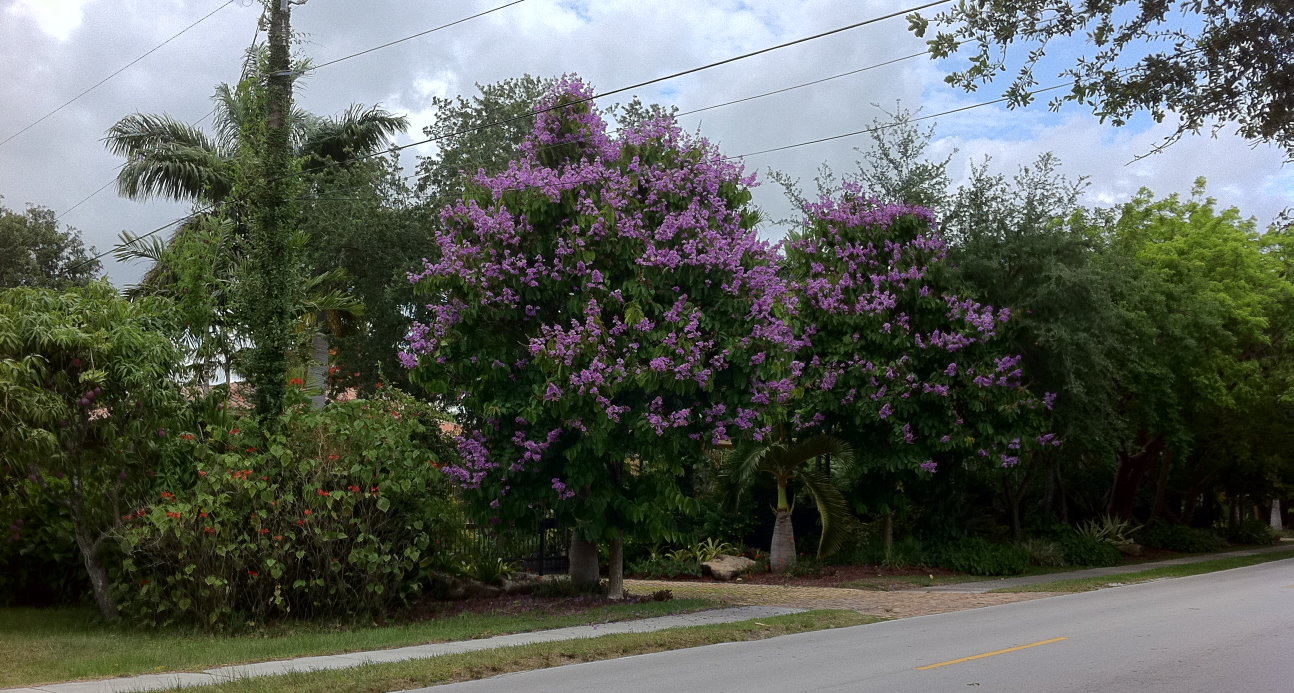
Lagerstroemia indica, commonly known as Crape myrtle or Crepe myrtle, is a genus of around 50 species of deciduous and evergreen trees and shrubs native to the Indian subcontinent, southeast Asia, northern Australia and parts of Oceania, cultivated in warmer climates around the world. It is a member of the Lythraceae, which is also known as the Loosestrife family. The genus is named after the Swedish merchant Magnus von Lagerström, who supplied Carolus Linnaeus with plants he collected.

The deciduous crape myrtle is among the longest blooming trees in existence with flowering periods lasting from 60-120 days. Crapes come in heights as short as 18 in and as tall as 40 ft. Leaves are alternate and smooth, but leaf size depends on variety. Flowers are borne in summer in big showy clusters and come in white and many shades of pink, purple, lavender and red.

These trees are on SW 67th Avenue, just North of 92nd street. They look better year after year.
Crape Myrtle

Sunday, May 29, 2011

Government Cut

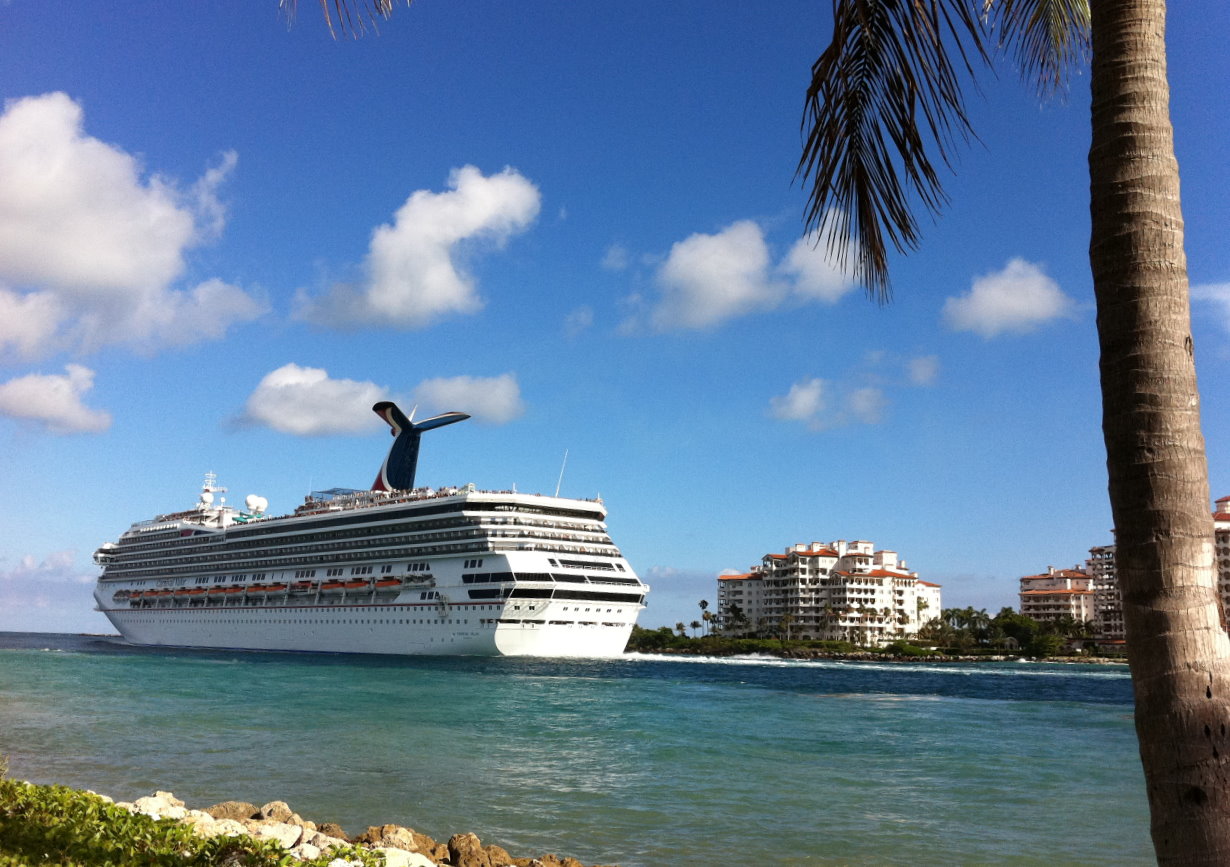
Government Cut is a man made shipping channel between Miami Beach and Fisher Island, which allows a direct access to the Port of Miami in Miami, Florida. Before the cut was established, a single peninsula of dry land stretched from what is now Miami Beach to what is now Fisher Island, and boats destined for the port at the mouth of the Miami River had to pass around Cape Florida, to the south of Key Biscayne.

Opened in 1905, the cut across the peninsula that is now Miami Beach was authorized by the U.S. government (hence the name), in order to provide a direct route from the Atlantic Ocean on the east to the seaport on Biscayne Bay to the west, without having to take a detour southward. The cut across the mangroves and beach at the southern end of the peninsula created Fisher Island, which, except for the extreme northeast corner, is part of unincorporated Miami-Dade County, Florida. The now famous South Beach is to the north of the cut.

This shot taken at 5:33PM today is from South Pointe Park. I got robbed and was charged US $25 to park in here where it should have been a free parking lot... Well, I was tipped to come here today to take a shot of a departing cruise ship so I was not about to be denied of this privilege for a mere $25! And here it is... The Carnival Valor was sailing out of its port of call via Government cut. You see Fisher island with its expensive condominium on the other side of the ocean water. If you are really interested to know where I was sitting, feed 25.7665,-80.136167 to http://maps.google.com. So, where does this big boat go today? It was set to deliver a 7 Night Exotic Western Caribbean Cruise to its riders, going to Grand Cayman, Roatan, Belize, and Cozumel. Here is its schedule:

Day Location Arrival Departure
1 Miami, Florida -- 04:00 PM
2 Fun Day At Sea -- --
3 Georgetown, Grand Cayman, Cayman Islands 07:00 AM 04:00 PM
4 Mahogany Bay, Isla Roatan 12:00 PM 07:00 PM
5 Belize City, Belize 08:00 AM 05:00 PM
6 Cozumel, Mexico 08:00 AM 05:00 PM
7 Fun Day At Sea -- --
8 Miami, Florida 08:00 AM --

Thank you, Gary, for your suggestion for my blog of today. It was worth the $25 parking fee.
Carnival Cruise

Saturday, May 28, 2011

Ficus elastica

On May 16th, I showed a Magnolia grandiflora tree with a magnificent immaculate white flower. A reader thought it might be instead the flower from a rubber fig. That was not really the case, and that prompted me to show you this photo of a true Ficus elastica, also called the rubber fig, rubber bush, rubber plant, or Indian rubber bush, which is a species of plant in the fig genus, native to northeast India and southern Indonesia. It is a fat bush in the banyan group of figs, growing to 130 ft tall, with a stout trunk up to 7 ft in diameter. The trunk develops aerial and buttressing roots to anchor it in the soil and help support heavy branches. It has broad shiny oval leaves up to 14 in long and 6 in width; leaf size is largest on young plants (such as this one,) and much smaller on older trees. The leaves in this photo measure to more than a foot on average. The rubber plant does not produce highly colorful or fragrant flowers to attract other pollinators. The flowers look like open multiple stem stars with yellow crests. However, I have never seen any flowers on the rubber figs growing in Miami.

Rubber Fig

Friday, May 27, 2011

Keitt Season

'Keitt' is a Florida mango which has become one of the world’s most outstanding and sought after fruit. Excellent eating quality, disease resistance, reliable high yield, and late ripening time are some of the features of this four to five pound Goliath. While the fruits are extremely disease resistant, the juvenile trees are very difficult to grow due to disease problems so this veteran tree is valuable, and its fruits come every year without fail. This is not my tree, but half of it intrudes on my side so I usually help myself with my share of it. The real problem is that the birds and squirrels get to them way before they are ready in late September, October when the fruits really are ripened properly.
Keitt

Thursday, May 26, 2011

Chevrolet 3116

I saw this vintage car in my rear view mirror this morning and had to take extraordinaire risks to snap a few decent photos of it. It carries the name "Chevrolet 3116" in chrome on its sides. I believe this is a 1957 Chevrolet 3116 Suburban Carryall that traced its roots to a model first introduced in 1935 and at the same time, had some elements of what we'd recognized today as a sport-utility vehicle. Its cousin was the Chevrolet 3106 Suburban Carryall.

Chevy's 1935 Carryall predated the modern all-steel station wagon by over a decade. Back then, it was nothing more than a panel delivery truck with windows in place of solid panels. However, it was all steel, and a lot easier to maintain than the conventional woody wagons of the time. The Carryall continued as Chevy trucks evolved from single-purpose workhorses, to civilized transportation in the mid-1950s, to upscale Chevrolet Suburban SUVs in the 1980s, but they always remained truck-based. Carryalls began to get civilized in 1955, with up-to-date car-like styling touches. The 1957 Chevrolet 3106/3116 Suburban Carryall was a mild facelift from the 1955-1956 models, led by a "floating" trapezoidal grille.
Chevrolet 3116

Wednesday, May 25, 2011

Hak Ip Too Tempting

Meet my Hak Ip lychee, fruiting for the first time. I took this photo this morning and planned to sample the fruits in a few days, waiting for them to ripen some more. Lo and behold, my yard men did not want to wait so they went ahead and helped themselves. Fancy that! Lucky they left me a few bunches so I can still know how they taste like.

Hak Ip lychees were introduced into South Florida just prior to hurricane Andrew in August 1992, and since have experienced widespread commercial plantings and are just now beginning to come into significant production here. This fruit has many desirable characteristics in a lychee: great flavor, large size, small seed and nice coloration. Lychee trees are monoecious meaning that an individual tree produces both male and female flowers. On the other hand, tropical fruit trees such as guavas, passion fruits, sugar apples, sapodillas and citrus produce flowers having both male and female sexual parts on the same flower, not like the lychees.
Former Parrot Jungle

Tuesday, May 24, 2011

Pinecrest Gardens

I miss the former Parrot Jungle that used to be here. Now it's changed to Pinecrest Gardens which is a 20-acre (81,000 m2) park in Pinecrest, Florida on the corner of Southwest 111th Street (Killian Drive) and Southwest 57th Avenue (Red Road). I used to get breakfast at the Parrot Jungle that started in 1936 until they relocated to the city of Miami's Watson Island in 2003. Now, the new Pinecrest Gardens includes a variety of sites including botanical gardens, butterfly exhibit, swan lake, petting zoo, children's playground, and a popular splash-n-play area. The park also hosts an annual fine arts festival, MagiCamp, and is available for rental for private parties, receptions, Admission is no longer free, and they charge US $3 for each visitor.
Former Parrot Jungle

Monday, May 23, 2011

Newly Bred Competition

Here is the second mobile US $10 orchid plant van that I find in South Miami. This man sets shop on SW 72nd Avenue just North of Sunset Drive. He is in direct competition with the first ever mobile orchid van. At first, I noticed that he was selling his plants for $12. Now his price is down to $10, the same as his direct competitor. The lady driving the white car just bought a plant from this man and she is ready to drive away.
Second Commerce

Sunday, May 22, 2011

Miami Sunset

This was taken at 7:48PM when the sun began to set in Miami. Not as good as at the beach, but better than nothing.
Sunset

Saturday, May 21, 2011

P. F. Chang

I knew about this restaurant for years, but never set foot in there until today, for a special lunch.

P. F. Chang's China Bistro, Inc. is an American restaurant chain with headquarters in Scottsdale, Arizona. This chain was founded in Scottsdale, Arizona in 1993 by Paul Fleming and Philip Chiang, thus its name P. F. Chang. I really don't know why the "i" was dropped from the name. I am willing to bet it has something to do with the lucky number 7. It is a rather successful chain with more than 200 restaurants in the United States, Mexico, Kuwait City, and Dubai in United Arab Emirates.

This photo is taken at the P. F. Chang located in the Falls and the place was quite crowded. I sampled quite a few things and had a great VIP duck. Delicious! I had to skip dinner tonight after that big lunch.
Chang-Chiang

Friday, May 20, 2011

Pricey Valet

This is trendy Sunset Drive in South Miami. There is a large number of trendy restaurants in this area, and parking is hard to find (for tourists, that is.) So the price to have your car "valet parked" is inching up. It was recently US $5.00. Now it is $7.00. I saw a sign saying $8.00 already. Just a half block from here, you can quite easily park yourself for much less. Not for me!
Valet

Thursday, May 19, 2011

La Dolce Vita

Late on a Thursday afternoon, I was at Scotty's Landing in Coconut Grove, watching this richly appearing catamaran sailboat docking to catch a dinner at this restaurant. Some do have it made, don't you think?
Leisurely Dinner

Wednesday, May 18, 2011

Cycad

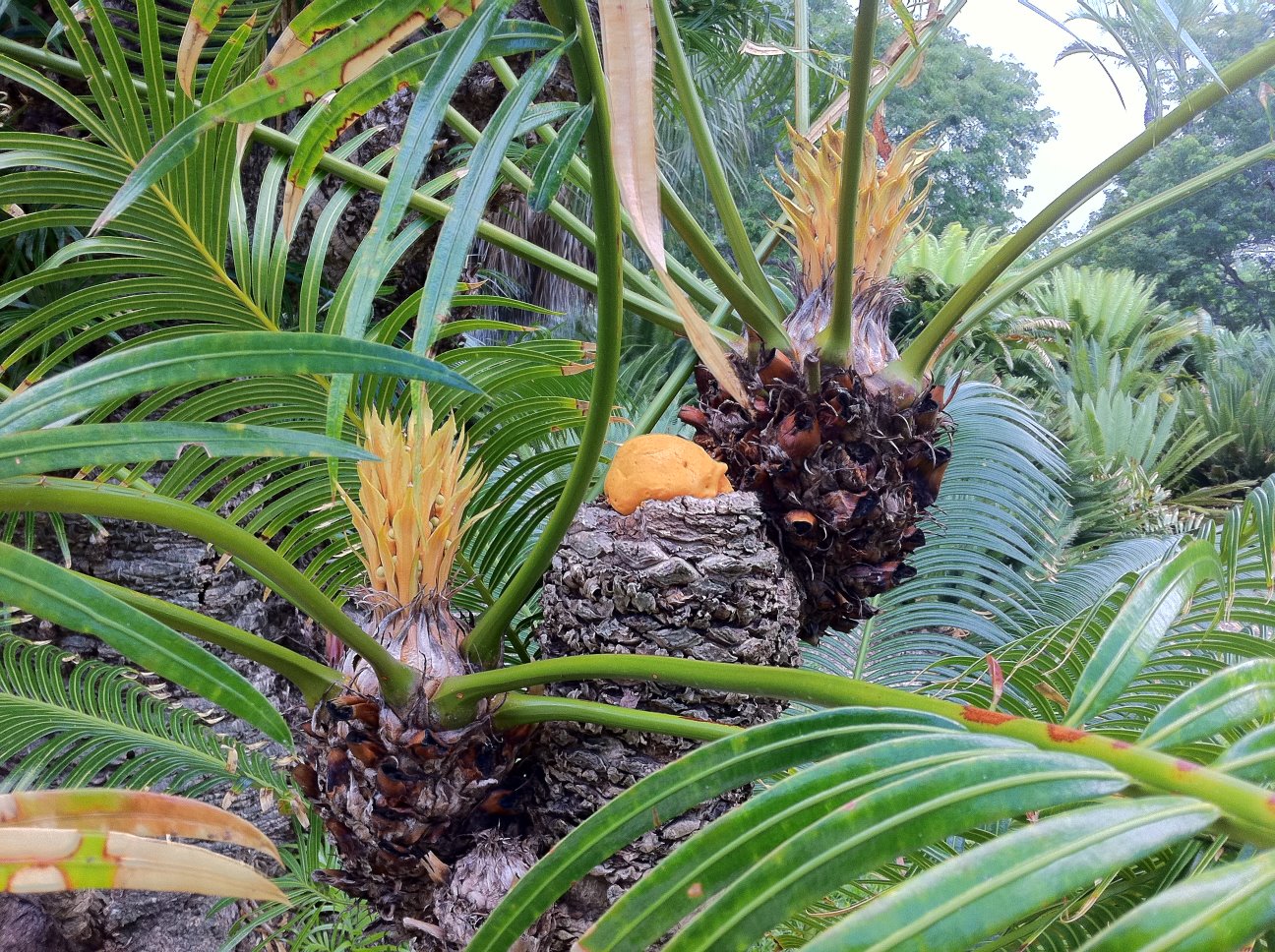
Cycads are seed plants typically characterized by a stout and woody (ligneous) trunk with a crown of large, hard and stiff, evergreen leaves. They usually have pinnately compound leaves. The individual plants are either all male or all female (dioecious). Cycads vary in size from having a trunk that is only a few centimeters tall to trunks up to several meters tall. They typically grow very slowly and live very long, with some specimens known to be as much as 1,000 years old. Because of their superficial appearance, they are sometimes confused with and mistaken for palms or ferns, but are only distantly related to both.

Cycads are found across much of the subtropical and tropical parts of the world. They are found in South and Central America (where the greatest diversity occurs), Mexico, the Antilles, southeastern United States, Australia, Melanesia, Micronesia, Japan, China, Southeast Asia, India, Sri Lanka, Madagascar, and southern and tropical Africa, where at least 65 species occur.

This is a Cycas aff. rumphii, a female plant, growing in the Montgomery Botanical Center in Miami.
Cycad

Monday, May 16, 2011

Streetside Magnolia

Magnolia is a large genus of about 210 flowering plant species in the subfamily Magnolioideae of the family Magnoliaceae. It is named after French botanist Pierre Magnol. Magnolia is an ancient genus. Having evolved before bees appeared, the flowers developed to encourage pollination by beetles. As a result, the carpels of Magnolia flowers are tough, to avoid damage by eating and crawling beetles. Here is tree growing outside in the street in a South Miami neighborhood that flowers every year.
Peacocks

Sunday, May 15, 2011

Zenny Peacocks

I returned to the Montgomery Botanical Center to find a herd of Indian peacocks enjoying a great Sunday afternoon stroll. How zen can this be?
Peacocks

Saturday, May 14, 2011

Wild Berries

Along the abandoned railroad track in South Miami are many treasures to be discovered. Here is a tree full of enticing "eat me now" which look like wild berries. However, cautious as I am, I am not taking any chance. I was hoping that the person who was with me would try first, but she was too smart to serve as guinea pig. The end result is that these fruits remain uneaten. I'll take some back for her cats to try. After a few days, if nothing is noticeable with the cats, I'll return for a good harvest.
Wild Berries

Friday, May 13, 2011

The Lone Lychee

This is a lychee tree planted to be a bonsai. Somehow, that didn't work out and I have no idea what to do next. This year, it decided to bear one fruit. Looks delicious to me. Dare I or dare I not eat it? What do you say?
Single Lychee

Thursday, May 12, 2011

As Low As The Ground

I love this... drooping royal poinciana. I can teach you how to play a suspenseful game of cock fight with the flower buds of this wonderful summer scarlet flower. If only they would be fragrant... Alas, they are not!
Early Gardenia

Wednesday, May 11, 2011

The Kid Is Back

Hey... Look... I'm back! Not a moment too soon. I am telling you that there is no place better than home, especially after you paid top bucks to suffer in Europe. Well, let's not talk about that else I will alienate tons of people. This is me landing in grand style at Miami international airport. The plane comes in from Northwest, overflying Doral. What you see is enclosed by Miami NW 74th street to the North, the Florida Turnpike to the West, Miami NW 107th Avenue to the East and Miami NW 58th Street to the South. A mere 30 years ago, this area was nothing but the everglades swamp.
The Kid is Back Home

Monday, April 25, 2011

Premature Blooming

There is "je ne sais quoi" in the Miami air this year that makes things come about a month earlier than usual. First, the yellow poinciana and now my gardenia. What's going on? Listen... My trusted fortune teller just told me that there is something going on with the planets, something retrograding or some weird, dangerous and may even be lethal thing that returns, Pluto returns? I just don't know! That may explain the early blooms. Just to be on the safe side, I am clamming up for about 2 weeks. OK? Will you miss my blog? See you when things return to normal, mid May, please say yes! If you really miss my blog, feel free to rant with your comments. Like Arnold would say... "I'll be BACK!" In the mean time... Do you see the cherries on the left side of this blog? Did you ever click on them? Lots of entertainment there while you wait for the planets to behave...
Early Gardenia

Sunday, April 24, 2011

Easter Sunday

No matter which religion one has, even one without one... This photo expresses a universal mood, one from which none of us can hope to escape.
Sadness on a Sunday

Saturday, April 23, 2011

Early Bloomer

This year, the flowers come very early for this yellow royal poinciana (Delonix regia var. flavida) To the left is a very delicious Zill mango, also with child. Zill, in case you do not know, is a variety of the excellent Hayden type.
Early Arrivial

Friday, April 22, 2011

My Twiner

What do you know... my Telosma is happily twining! As opposed to be something that climbs with tendrils or coiling leafstalks. That will be another story for another day because then I would be talking about my new baby vines that coil, two baby jade vines (Strongylodon macrobotrys.)

I know that vines, if left to their own device, cannot grow well without adequate support. The Telosma cordata (Thien Ly in Vietnamese, meaning "a thousand miles") does not flourish without a helping hand. So I obliged and gave mine just that, a helping hand. I guided a new growth around the stem of a small jatropha plant. That was exactly the invitation it waited for and this new stem of my Telosma took off and grew furiously, much faster than when it was left twisting in the wind, literally. Now that that theory is validated (twiner vines need a thing or two to twine around to be happy,) I would love to test the next hypothesis: Can this vine really live up to its name of "thousand mile vine?" I need a thousand mile long slender stem so my Telosma can twine around as its heart desires. Now, where can I find that? A thousand mile? My vine would reach Washington DC. So cool! That will be better than Jack's beanstalk. By the way, if you revisit your childhood book with the fairy tale of Jack, you'd discover that beanstalk twines too.
It's Twining

Thursday, April 21, 2011

iPad Dinner

I am ashamed to admit that I was again at the Shorty's place tonight. There was an excuse though: I was not the only one... there was a long line of patrons waiting to get in here for food. Thursday nights are always favorite nights for Americans to eat out. Would you believe that my neighbor brought his iPad to dinner? Naturally, I told him about Miami Every Day so we went there just for fun while his food attendant patiently waited. I promised this very friendly man that his iPad would be featured tonight, and here it is, promise kept!
iPad

Wednesday, April 20, 2011

Just Like A Painting

It's getting hot in Miami... just like the summer is already here... Yeah, it's here, or at least, it feels like it's here. More heat makes more clouds like these and each one of these cotton bunches is a potential rain maker. April showers bring May flowers. I'd better get busy to check upon my roof. The rains are coming...
Like a Painting

Tuesday, April 19, 2011

Huge Sausages

I thought it hard to find sausage trees in Miami that bear fruits. Wrong! So, you can't really believe what you read... that said it's hard to find sausage fruits in South Florida because there are no bats to pollinate the trees. I have found several trees in the last few days, and they all bear a large amount of huge sausages like this one here at the Wayside stand on Red Road. You probably do not want to sit under these things because if they fall upon your head, you'd be dead, I think.
Sausages